
TLDR: Tobacco use testing finds the chemical "footprints" of tobacco, mainly by looking for nicotine's stable byproduct, cotinine. By analyzing samples like urine, saliva, or hair, these tests give a clear picture of recent or long-term use. This is a proven way to verify smoking status for health checks, insurance, and clinical research.

When you hear about tobacco use testing, it’s not just about catching someone smoking. It's a scientific method for confirming exposure to tobacco. The process looks for specific chemical clues left behind in the body.
The main suspects are nicotine and its key byproduct, cotinine. These tests check biological samples—like urine or saliva—to get a clear picture of recent use.
What Tobacco Use Testing Really Tells Us
Think of it like a biological detective story. When someone uses a tobacco product, their body immediately gets to work processing the nicotine. In doing so, it creates and leaves behind certain tell-tale clues.
The most reliable of these clues is a substance called cotinine. While nicotine itself is a bit of a fleeting character and disappears from the body pretty quickly, cotinine hangs around for much longer.
This longer lifespan is what makes it such a dependable marker for confirming tobacco exposure. In fact, testing for cotinine gives a far more accurate and reliable picture than just searching for nicotine alone.
Why It Matters
Knowing a person’s true tobacco use status is critical in many different scenarios. It helps doctors and healthcare providers tailor the right support and cessation plans. It also gives insurance companies the accurate information they need to assess risk fairly.
For scientists and researchers, it’s the only way to gather truly reliable data for studies. At its core, the goal is to get objective, undeniable proof of tobacco exposure.
For anyone committed to understanding this topic on a deeper level, it's worth digging into the science. You can find more detailed and objective information by exploring resources on nicotine facts.
How Tobacco Use Testing Actually Works
Think of tobacco use like leaving footprints in the sand. Nicotine is the fresh, clear footprint left right after a step—it's there, but the tide will wash it away quickly.
Cotinine, a substance your body makes from nicotine, is like a plaster cast of that footprint. It lasts much longer and gives a clearer, more durable record of what happened.
That’s why cotinine, not nicotine, is the real star of the show in tobacco testing.
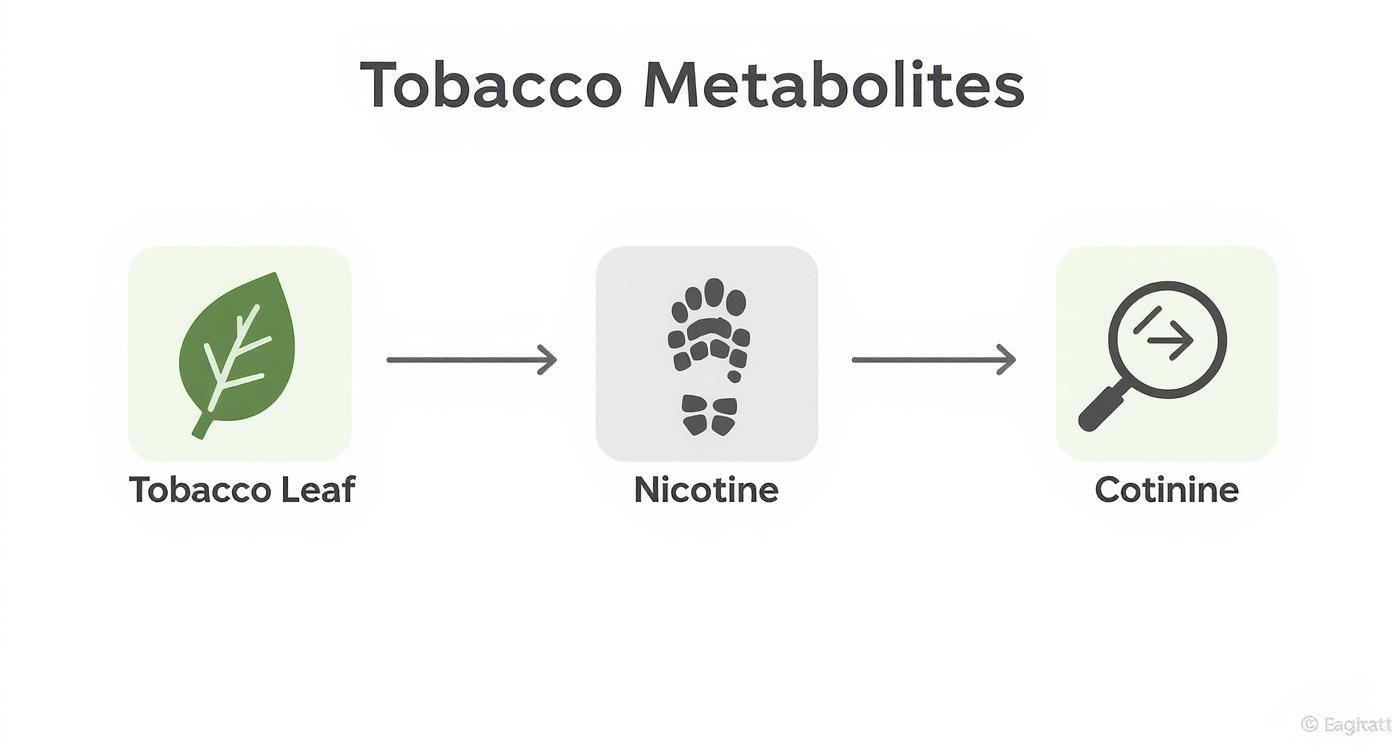
To really get how these tests work, you have to follow the chemical trail left behind in the body. When someone smokes a cigarette, vapes, or uses a nicotine pouch, nicotine floods their system.
It's the compound that gives tobacco its kick. But nicotine is a fleeting guest.
It has a very short half-life—the time it takes for your body to clear out half of it—of only about two hours. This means if you were trying to test for nicotine itself, you'd have a tiny window to catch it.
The Transformation: From Nicotine to Cotinine
Your liver is a master at processing everything you put into your body, and nicotine is no exception. When nicotine shows up, the liver quickly breaks it down into various other compounds, called metabolites.
The most important one for testing purposes is cotinine. It’s a simple conversion: nicotine comes in, and the liver turns about 70-80% of it into cotinine.
This metabolic process is the key to reliable testing. Why? Because unlike its parent compound, cotinine sticks around for a whole lot longer.
It has a half-life of roughly 16 to 20 hours. This extended stay makes it the perfect biomarker—a biological signpost—for recent tobacco exposure.
A biomarker like cotinine gives us a historical record, not just a momentary snapshot. Searching for nicotine is like trying to catch a sprinter in a photo finish; finding cotinine is like looking at the official race results posted hours later. It’s just far more dependable.
Why Cotinine Is the Gold Standard
That much longer detection window is precisely why cotinine has become the preferred target for almost every type of tobacco test. It paints a more complete picture of someone’s tobacco use over the past few days, not just the last couple of hours.
This stability gives testers several major advantages:
- A Wider Window: You can find cotinine in urine for up to three or four days after someone last used tobacco.
- Shows a Pattern of Use: Cotinine levels can help tell the difference between a daily smoker and a casual user.
- Highly Specific: Cotinine is produced almost exclusively from nicotine, meaning the risk of a false positive is practically zero.
By focusing on this stable metabolite, labs can confidently determine if someone has been exposed to nicotine. Cigarettes, vapes, chew, or patches—they all leave the same trail of cotinine.
This simple metabolic trail is precisely why cotinine has become the gold standard biomarker for accurate tobacco use testing.
Comparing Different Types of Test Samples
Choosing the right sample for a tobacco test is like picking the right tool for a job. You wouldn't use a sledgehammer to hang a picture frame.
Each sample type—urine, saliva, blood, and hair—offers a unique window into a person's tobacco exposure. Understanding their individual strengths and weaknesses is absolutely critical.
Let's break down these biological "detectives" to see what secrets each one can uncover.
Urine Testing: The Reliable Workhorse
Urine testing is, by far, the most common method for detecting tobacco use. It’s non-invasive, cost-effective, and provides a dependable look at recent exposure. Think of it as the family sedan of testing—it gets the job done consistently and affordably.
A urine test primarily looks for cotinine, which can typically be detected for about 3 to 4 days after last use. For heavy, long-term smokers, this window can sometimes stretch to a week or even more.
This makes it ideal for common scenarios, like pre-employment screening or insurance applications.
Saliva Testing: The Rapid Responder
If urine testing is the reliable sedan, then saliva testing is the nimble scooter—perfect for quick, on-the-spot checks. Saliva tests are incredibly easy to administer, requiring just a simple swab of the mouth.
This has made them a popular choice for situations that need immediate results. The trade-off for this speed and convenience is a shorter detection window.
Cotinine is usually only detectable in saliva for about 24 to 48 hours after the last use. This makes it highly effective for confirming very recent tobacco consumption.
Blood Testing: The Forensic Expert
Blood testing is the forensic specialist in the world of tobacco screening. It offers the highest level of accuracy and precision you can get. It can measure the exact concentration of both nicotine and cotinine in the bloodstream.
This makes it invaluable for scientific research where exact exposure levels are critical. However, this precision comes at a price.
Blood tests are the most invasive and expensive method. The detection windows are also relatively short: nicotine is gone in hours, while cotinine can be found for up to 2-3 days.
Because of its invasive nature and cost, blood testing is generally reserved for situations where quantitative data is essential. For most routine screenings, the accuracy of urine or saliva tests is more than sufficient.
Hair Testing: The Historian
Finally, we have hair testing—the long-term historian. While other tests give you a snapshot of the last few days, a hair follicle test provides a panoramic view of the past several months.
As your hair grows, it traps biomarkers like cotinine, creating a permanent timeline of exposure. A standard 1.5-inch hair sample can reveal tobacco use patterns over the previous 90 days.
This makes it an excellent tool for monitoring long-term abstinence in smoking cessation programs. The main downsides are its cost and inability to detect very recent use.
Long-term monitoring is part of a larger global strategy to curb tobacco use. For instance, the push for graphic health warnings on tobacco packaging has seen incredible progress. You can read the full report on global tobacco epidemic trends for more details.
Each testing method offers a different piece of the puzzle. The table below breaks down the key differences.
Comparing Tobacco Test Sample Types
| Sample Type | Detection Window | Accuracy | Invasiveness & Cost | Best For |
|---|---|---|---|---|
| Urine | 3-4 days (up to 1-2 weeks for heavy users) | High for detecting recent use. | Non-invasive & Low Cost. | Routine screenings, insurance, employment, and smoking cessation check-ins. |
| Saliva | 24-48 hours | High for very recent use. | Non-invasive & Low-to-Moderate Cost. | On-the-spot testing, roadside checks, and verifying use within the last day. |
| Blood | 2-3 days (Nicotine: just hours) | Very High (Quantitative). Measures exact concentrations. | Invasive & High Cost. Requires a clinical setting. | Scientific research, clinical trials, and situations needing precise data. |
| Hair | Up to 90 days or longer. | High for long-term patterns. | Minimally invasive & High Cost. | Long-term abstinence monitoring, legal cases, and historical use verification. |
Ultimately, the best test depends entirely on what you need to find out. Are you looking for a quick "yes" or "no," or do you need a detailed history? Answering that question is the first step in choosing the right tool.
Understanding Test Accuracy and Limitations
TLDR: No tobacco use test is 100% flawless. Test accuracy is measured by sensitivity (correctly identifying users) and specificity (correctly identifying non-users). Things like heavy secondhand smoke or testing too early/late can cause errors, which is why follow-up tests are sometimes needed for a complete picture.
While today's tobacco tests are incredibly reliable, no single test is perfect. Think of it like any other diagnostic tool—each one comes with its own strengths and potential weaknesses.
Understanding these nuances is the key to interpreting the results correctly. Test accuracy isn't just a simple "yes" or "no" answer.
It's really a delicate balance between two core concepts: sensitivity and specificity. Once you get a handle on these two ideas, you’ll have a much clearer picture of what a test result truly means.
Sensitivity and Specificity Explained
Imagine a test is like a security guard at an exclusive event. The guard has two main jobs: let the invited guests in and keep uninvited people out.
Test accuracy works pretty much the same way.
- Sensitivity is the test's ability to correctly identify a tobacco user. This is the guard successfully spotting every single person who tries to crash the party.
- Specificity is the test's ability to correctly identify a non-user. This is the guard recognizing all the invited guests and waving them through without any issue.
In a perfect world, a test would be 100% sensitive and 100% specific. In reality, labs work hard to get as close to this ideal as possible.
The Puzzle of a False Positive
A false positive is when a test flags someone for tobacco use when they haven't actually used it. This is our security guard mistakenly accusing an invited guest of being a party crasher.
While this is very rare with modern cotinine tests, a few things can muddy the waters. The most commonly cited concern is heavy, prolonged exposure to secondhand smoke.
For a non-smoker to test positive, they'd likely need to be in a small, unventilated room with intense smoke for many hours. The cotinine levels from passive exposure are typically far below the cutoffs for standard tests.
It's important to understand that a positive result from a highly specific test, like a cotinine screen, is overwhelmingly likely to be accurate. The scenarios that might lead to a false positive are outliers, not everyday occurrences.
Unpacking a False Negative Result
On the other side of the coin, you have the false negative. This happens when a test fails to detect tobacco use in someone who is a user. This is our security guard failing to notice a party crasher slipping right past them.
This type of error is more common and usually comes down to simple timing. The biggest reason for a false negative is testing outside the detection window.
If someone uses tobacco and then waits just long enough for the cotinine to clear, the test will come back negative. The level of exposure also matters.
Ultimately, understanding a test's limitations is empowering. It gives you a realistic view of what the results mean and underscores why context is so incredibly important.
Where Tobacco Testing Is Used in the Real World
TLDR: Tobacco use testing isn't just a lab procedure—it's a practical tool used every day to improve health and safety. It's essential in workplaces to ensure safety, in clinical trials to guarantee accurate research data, and in smoking cessation programs to provide motivation and track real progress. From insurance applications to personal health journeys, these tests offer objective proof of tobacco exposure, turning scientific data into real-world action.
The science behind tobacco use testing is fascinating, but its real power comes from its use in everyday life. These tests are much more than academic exercises. They are practical tools that influence major decisions in healthcare, workplaces, and scientific research.
Understanding where and why these tests are deployed helps connect the dots. From making sure a construction worker is alert to verifying data in a medical study, tobacco testing plays a crucial role.
Workplace Screening Programs
Many employers, especially in safety-sensitive industries, include nicotine screening in their hiring process. Think about jobs where a split-second lapse in concentration could be catastrophic—like airline pilots or heavy machinery operators.
Companies often test for nicotine to minimize risks and ensure their team is focused and healthy. Insurance is another major driver.
Companies that enforce smoke-free workplace policies often get lower premiums on health and life insurance. Tobacco use testing gives them a verifiable way to uphold these policies.
Validating Clinical Trial Data
Scientific research, particularly in medicine, must be built on clean, reliable data. When scientists study a new drug, a participant's smoking status can throw off the results in a big way.
Imagine a study testing a new lung health medication. If a chunk of the "non-smoker" group is actually smoking, the study’s findings could be completely skewed.
To prevent this, researchers use cotinine tests to biochemically confirm that the non-smoking group is truly smoke-free.
In research, what people say they do doesn't always match reality. Self-reporting is notoriously unreliable, which is why objective biochemical verification through tobacco use testing is the gold standard for ensuring the integrity of clinical trial data.
Blood tests are often the top choice in these settings because they deliver precise data. This step ensures that the conclusions drawn from the research are valid and can be trusted.
Supporting Smoking Cessation Programs
Quitting tobacco is an incredibly tough journey, and getting objective feedback can be a powerful motivator. Smoking cessation programs often use cotinine testing to help people track their progress.
Seeing a test result come back negative delivers a tangible win, reinforcing their commitment. These tests also help healthcare providers tailor their support.
For anyone on this path, learning the facts can be empowering. You can understand the science behind nicotine to arm yourself with more objective information.
Despite the difficulty of quitting, global efforts are making a real impact. Tobacco use has been on a downward trend, with the number of users dropping. You can find more insights in the World Health Organization's report on tobacco trends.
Frequently Asked Questions About Tobacco Testing
Long story short: Yes, vapes and e-cigarettes absolutely show up on standard tests. We'll also explain how labs can easily tell the difference between a smoker and someone who's just been around secondhand smoke. And finally, we'll give you a clear breakdown of how long nicotine and its byproducts hang around in your urine, saliva, blood, and hair.
Digging into the world of tobacco use testing always brings up some very specific questions. The science is one thing, but how it all plays out in real life is what most people really want to know.
Let's cut through the noise and get straight to the answers for the most common questions we hear.
Can Secondhand Smoke Make Me Fail a Test?
This is probably the number one question we get, and the short answer is: it’s virtually impossible. While you do absorb tiny amounts of nicotine from passive smoke, modern lab tests are designed to tell the difference.
Think of it this way: a test is looking for a flood, not just a bit of morning dew. Labs set a specific cutoff level for cotinine, and your sample has to be above that level to be considered positive.
The amount of cotinine from even heavy secondhand exposure almost never comes close to these thresholds. For everyday life, the risk is practically zero.
Key Takeaway: Don't sweat the secondhand smoke. Lab tests are smart enough to distinguish the high cotinine levels of an active user from the trace amounts you might get from passive exposure.
How Long Does Nicotine Actually Stay in My System?
This is a tricky one because the answer really depends on what’s being tested—and on you. Nicotine itself disappears pretty quickly, but its main byproduct, cotinine, sticks around much longer.
Here’s a general guide to how long labs can detect cotinine:
- Urine: For a casual user, cotinine is usually detectable for about 3 to 4 days.
- Saliva: Saliva has a much shorter memory, detecting cotinine for only about 24 to 48 hours.
- Blood: A blood test can spot cotinine for up to 2 or 3 days.
- Hair: Hair is the ultimate long-term record keeper, revealing use for up to 90 days.
Keep in mind, these are just estimates. Things like your personal metabolism and how much you use can affect how quickly your body gets rid of these substances.
Do Vapes and E-Cigarettes Show Up on Tests?
Yes, one hundred percent. This is a huge point of confusion.
Tobacco use testing isn't just about cigarettes—it's about nicotine, plain and simple. It doesn't matter if that nicotine came from a cigarette, a vape, a nicotine pouch, or a patch.
When you use any of these products, your liver breaks down the nicotine into cotinine. A standard lab test is just looking for that cotinine.
The result is the same: a positive test for nicotine use. In fact, the explosion of new nicotine products has made this kind of testing more important than ever.
If you have other questions or want to get into the weeds on a specific part of tobacco testing, please feel free to reach out to our team of experts. We're here to give you clear, objective information.
At Nic Facts, we are dedicated to providing clear, objective, and evidence-based information about nicotine. Explore our resources to deepen your understanding at https://nicfacts.org.
Leave a Reply