TLDR: The Smoking & Mental Health Spiral
- The Illusion: Smoking feels like stress relief, but it's a trick. That "calm" is just your brain quieting the withdrawal symptoms that nicotine created in the first place.
- The Brain Heist: Think of nicotine as a high-interest loan for your brain's feel-good chemicals. You get a short-term boost, but the long-term cost is a chemical deficit that makes you feel anxious and irritable.
- The Payoff of Quitting: Kicking the habit is one of the best things you can do for your mental health. Studies show the mood boost can be as powerful as taking antidepressants, leading to lower anxiety and stress.
Digging Deeper: How Smoking Really Affects Your Mind
The relationship between smoking and mental well-being is tricky and often flipped upside down. Many people reach for a cigarette to calm their nerves, but the science reveals a more complicated truth. That fleeting sense of relief is mostly just quieting the craving and irritability that nicotine withdrawal caused.
This guide will break down the science behind how smoking impacts your brain and mood.
We’ll explore:
- Why the "stress relief" from a cigarette is actually an illusion.
- How nicotine physically changes your brain's reward pathways.
- The surprising and significant mental health boost that comes with quitting for good.
Getting a clear picture of this cycle is the first real step toward breaking free. If you're interested in how nicotine is detected, you can find more information about the nicotine test.
The Myth of Smoking as a Stress Reliever
Let's bust one of the biggest myths about smoking right now. The calm you feel from a cigarette isn't real stress relief; it's a temporary fix. That fleeting sense of peace is just your brain getting its nicotine hit, which silences the withdrawal symptoms created by the addiction.
It’s a powerful illusion, and one that keeps millions of people hooked.

So many people grab a cigarette during a rough day, convinced it’s their go-to tool for managing stress. That initial drag can feel like a genuine wave of calm, reinforcing the belief that smoking helps you relax. This experience feels incredibly real, which is why the link is such a stubborn myth.
But what's actually happening is one of nicotine's most clever tricks. The calm isn't a genuine reduction of your life's stress. It's almost entirely the silencing of nicotine withdrawal.
Shortly after you finish a cigarette, your body starts craving the next one. This creates a low-grade, constant hum of irritability and anxiety. This process locks you into a self-perpetuating cycle where you smoke to fix a problem that smoking created.
A Payday Loan for Your Brain
To really grasp the true cost of this "relief," think of nicotine as a high-interest payday loan for your brain’s mood chemicals. When you smoke, nicotine forces a rapid release of dopamine, the brain's "feel-good" chemical, giving you an immediate but artificial lift. This is the loan—a quick, easy hit of pleasure.
But this loan has terrible terms. Your brain, trying to adapt to these constant, unnatural dopamine spikes, starts producing less of its own. Over time, it starts depending on nicotine just to feel normal, not to feel good.
This is the chemical debt, and it's where the real damage to mental health begins. The anxiety and tension you feel between cigarettes are amplified by the nagging, persistent symptoms of nicotine withdrawal.
The cycle of addiction can lead to withdrawal symptoms that worsen mental health issues. While nicotine may offer temporary relief, long-term use is linked to higher levels of anxiety and depression.
Unmasking the Real Source of Calm
That feeling of relief you get from smoking is nothing more than the temporary reversal of the awful state the addiction itself created. This is exactly why quitting is so hard. You aren't just giving up a habit; you're facing the full force of withdrawal symptoms your brain has been using nicotine to mask.
Think about the long-term consequences of this cycle:
- Higher Baseline Anxiety: Over time, studies consistently show that smokers report higher overall stress levels than non-smokers.
- Dependency on a Chemical Fix: Instead of learning healthy ways to cope, the brain becomes trained to rely on an external chemical.
- Masking Deeper Problems: Smoking can act as a smokescreen, hiding the real sources of your stress or underlying mental health conditions.
Breaking free from this cycle is about reclaiming your brain's natural ability to manage your mood. The road can be bumpy, but the reward is a genuine, stable sense of well-being. This reward isn't dictated by the highs and lows of a nicotine addiction.
The Vicious Cycle: How Smoking and Mental Health Feed Each Other
It’s easy to think of smoking and mental health as separate issues. In reality, they're tangled up in a destructive feedback loop. People often start smoking to cope with feelings like anxiety or depression.
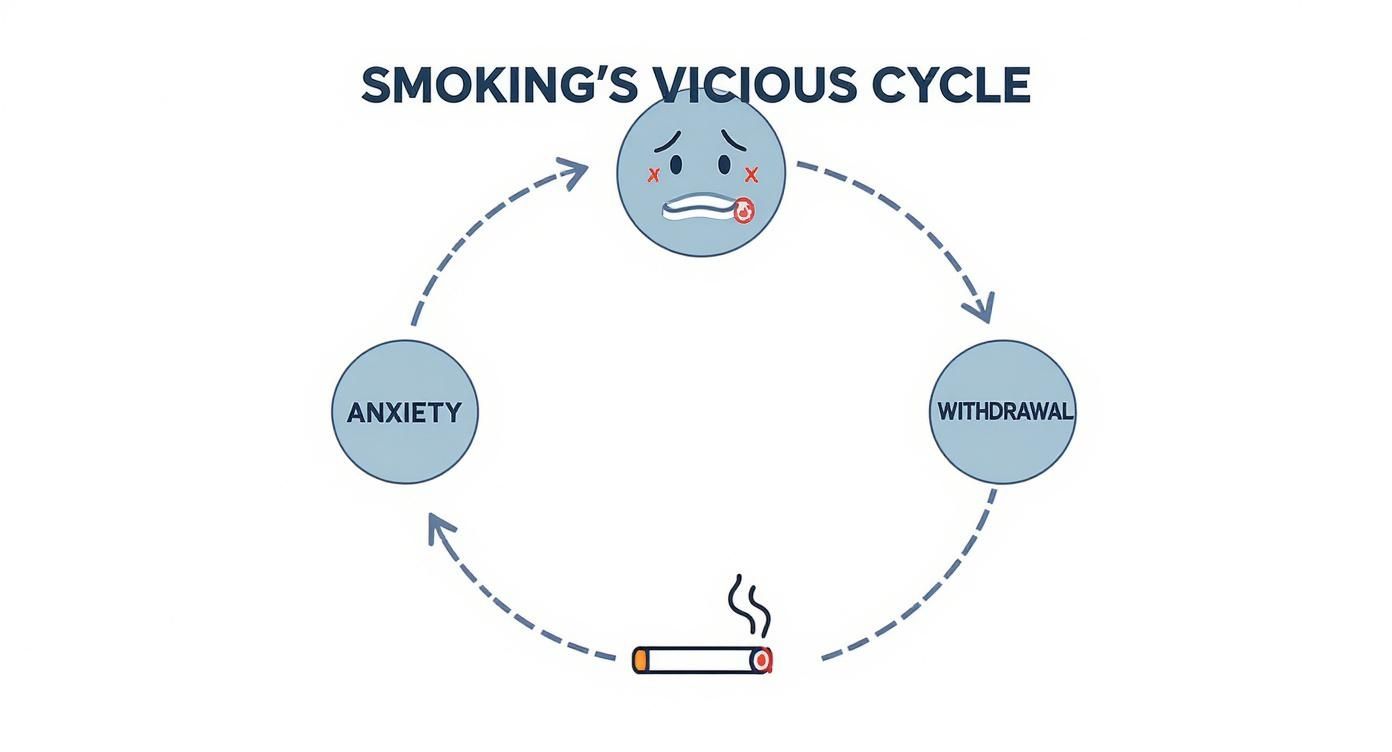
The cruel irony is that while a cigarette might offer a fleeting moment of calm, it's the withdrawal that follows which ramps up anxiety. This creates a powerful urge to smoke again just to feel normal. You become trapped in a cycle that's tough to break.
This relationship isn't a one-way street; one problem doesn’t just cause the other—it actively fuels it. This is why the smoking effects on mental health are so devastating. It's why so many people get stuck in this downward spiral.
Picture it this way: you're feeling anxious, so you reach for a cigarette. That first drag delivers a quick hit of nicotine, which triggers a small dopamine release in your brain. For a few minutes, you feel a sense of relief.
How the Spiral Works
Once that initial nicotine buzz fades, your body goes into withdrawal. The symptoms—irritability, restlessness, and a sharp spike in anxiety—are often identical to the feelings you were trying to escape. Your brain screams that another cigarette is the only way to fix it.
This locks you into a deeply deceptive pattern:
- The Trigger: You feel a negative emotion, like stress or sadness.
- The Quick Fix: You smoke a cigarette for that fast, temporary relief.
- The Aftermath: Nicotine withdrawal kicks in, making you feel even more anxious or irritable than before.
- The Misleading Lesson: Your brain blames these new negative feelings on the absence of nicotine, not on the smoking itself.
This is a huge reason why people with existing mental health challenges are more likely to start smoking. It also explains why they find it so much harder to quit.
A Two-Way Connection
The evidence is clear: this is a two-way street. People with mental health conditions are far more likely to be smokers, and smokers are far more likely to develop those same conditions. It's a classic chicken-and-egg situation where each problem compounds the other.
The numbers don't lie. Smokers are more than twice as likely to struggle with conditions like anxiety compared to non-smokers. Data from Australia revealed that 9.3% of smokers deal with anxiety, while that figure is just 4.5% for non-smokers.
As you can see from resources at ASH.org.uk, tackling this connection is a critical public health issue. Even exposure to secondhand smoke has been linked to a higher risk of depressive symptoms. The mental health impact can extend to family, friends, and coworkers.
The core of the cycle is this: nicotine offers temporary relief from symptoms it helps create. This illusion of control keeps the user dependent while chipping away at their underlying mental resilience over time.
Why This Cycle Is So Hard to Escape
Breaking free means fighting a war on two fronts at once. You have to manage your mental health symptoms while simultaneously battling a powerful chemical addiction. When you try to quit, withdrawal can make you feel even more depressed or anxious for a short time.
This is the cycle's most powerful illusion, tricking you into believing that quitting is actually making things worse. The truth is, pushing through that initial rough patch is the only path to freedom. It’s the only way to give your brain a chance to heal and recalibrate.
How Nicotine Chemically Hijacks Your Brain
In short, nicotine acts like a master key in your brain. It unlocks a flood of the "feel-good" chemical dopamine, creating a powerful but temporary sense of pleasure. The catch? Your brain quickly adapts by building more locks (receptors) and dialing down its own natural dopamine supply.
This is how dependency starts. You end up needing nicotine just to feel normal. That whole awful experience of withdrawal and cravings isn't a failure of willpower; it's a very real sign your brain's chemistry has been rewired.
This visual shows the vicious cycle perfectly: anxiety prompts you to smoke for relief. But that relief is short-lived and leads to withdrawal, which then spikes your anxiety even higher. The temporary fix is what actually keeps the cycle of distress going.
To really grasp the powerful smoking effects on mental health, we have to look at what’s happening on a chemical level. Nicotine is such an effective drug because it mimics a natural process in your brain, then completely takes over the controls. Think of your brain's internal communication system as a network of locks and keys.
Neurotransmitters are the keys, fitting into specific receptors—the locks—to deliver messages. Nicotine’s chemical structure is so similar to a natural neurotransmitter called acetylcholine that it can act as a master key. But this master key doesn't just open the door; it kicks it wide open.
The Dopamine Flood and the Artificial Reward
Dopamine is your brain's reward and motivation chemical. It’s what tells you, "Hey, that was good. Let's do that again!" When you eat a great meal or laugh with friends, your brain releases a small, healthy dose of dopamine.
Nicotine, on the other hand, unleashes a dopamine flood. This intense, artificial rush of pleasure forges an incredibly strong link between smoking and feeling good. Your brain’s learning center then logs this as a powerful memory: smoking equals immense reward.
This is exactly why cravings can be triggered by certain places, feelings, or even the time of day. Your brain has learned to associate those cues with the promise of that dopamine hit. It’s a tough lesson to unlearn.
Your Brain's Smart—But Tricky—Adaptation
Your brain is an expert at maintaining balance, or homeostasis. When it's constantly flooded with nicotine-induced dopamine, it knows something is off. To regain control, it starts making adjustments.
The brain's adaptation to nicotine is the very foundation of addiction. It reduces its own sensitivity to pleasure while increasing its demand for the substance, creating a chemical trap that's incredibly difficult to escape without understanding how it works.
To counteract the constant overstimulation, your brain does two key things:
- It Desensitizes Receptors: The existing "locks" for dopamine become less sensitive, meaning you need more dopamine to get the same feel-good effect.
- It Builds More Locks: Your brain literally grows more nicotinic acetylcholine receptors, a process known as upregulation.
This whole adaptation process is what we call tolerance. The cigarette that once gave you a strong buzz just doesn't do the trick anymore. You find yourself needing to smoke more often just to get back to that initial feeling.
The Chemical Roots of Withdrawal
This rewired brain is now physically dependent on nicotine to function at its new "normal." When you suddenly stop smoking, all those extra, empty receptors start screaming for nicotine. At the same time, your brain’s natural dopamine production has been suppressed, leaving you in a significant chemical deficit.
This imbalance is the direct, physical cause of withdrawal symptoms. The irritability, anxiety, depression, and brain fog aren't "all in your head." They are tangible, physiological responses to your brain chemistry being completely out of whack.
The very feelings that people often smoke to manage—stress and anxiety—become amplified tenfold during withdrawal. This creates the powerful illusion that you need a cigarette to feel okay. You just need it to quiet the chemical chaos that years of smoking created.
The Mental Health Gains of Quitting Smoking
If you're a smoker, you might worry that quitting will send your anxiety or depression through the roof. It’s a common fear, but the reality is exactly the opposite. Kicking the habit is one of the single best things you can do for your mental well-being.
In fact, studies show the mood boost can be as powerful as taking antidepressants.
The Myth of the Calming Cigarette
Let's get one of the biggest myths out of the way first. That "ahhh" moment you feel when you light up isn't true calm. It's just the temporary satisfaction of feeding a nicotine craving.
Your brain is quieting the withdrawal symptoms that were making you feel irritable and anxious in the first place. You're not solving stress; you're just putting a band-aid on a problem that the cigarette created.
The truth is, quitting smoking is consistently linked to lower levels of depression, anxiety, and stress. It's like stepping off a chemical rollercoaster. Your brain finally has a chance to find its natural, steady rhythm again.
What’s Really Happening in Your Brain
To understand why quitting feels so good long-term, you have to look at the brain chemistry involved. When you smoke, nicotine hijacks your brain's reward system. This means your brain becomes dependent on nicotine to release dopamine.
After quitting, it takes a little time, but your brain chemistry begins to heal and recalibrate. It starts producing and managing its own dopamine again. This allows you to experience genuine pleasure from everyday life, and your mood stabilizes.
This rebalancing act is the key to the massive mental health improvements. People feel this boost once they're smoke-free for good.
A Powerful, Unexpected Benefit
The positive shift is so significant that it's often compared to other forms of mental health treatment. For many, the improvement in their mood is one of the most surprising and welcome rewards of quitting.
Research has shown that quitting smoking can be as effective as antidepressants for treating mood and anxiety disorders. This highlights that cessation is not a sacrifice for your mental health, but a direct and potent treatment for it.
The first few weeks can be tough, no doubt. But the long-term payoff is incredible. People who quit successfully almost always report feeling calmer, happier, and more in control of their emotions than they ever did while smoking.
Many ex-smokers discover that the constant, low-grade anxiety they thought was just "part of their personality" was actually a symptom of nicotine withdrawal. Once that chemical noise disappears, they find a sense of inner calm they never knew was possible.
Quitting When You're Also Managing a Mental Health Condition
For anyone with schizophrenia, bipolar disorder, or severe depression, quitting smoking is more than just ditching a bad habit. It’s often about dismantling a core coping mechanism. Nicotine can feel like a tool for self-medication.
Quitting can throw that delicate balance into chaos. It can even mess with psychiatric medications, which is why a plan that tackles both smoking and mental health together isn't just a good idea—it's essential.
While kicking the habit is tough for anyone, it can feel like a different beast when you’re also navigating a mental health condition. For many, smoking becomes a way to self-medicate. That quick hit of nicotine offers a fleeting moment of calm or focus.
This isn't just in your head; it’s a deeply wired neurochemical response. The brain comes to depend on nicotine to feel "normal." This explains why the connection between smoking and mental illness is so powerful and, tragically, so damaging.
Why You Can't Treat Them Separately
Trying to quit smoking without accounting for a serious mental illness is like trying to patch a leak in the roof during a hurricane. You’re missing the bigger picture. The two issues are completely intertwined.
This is where integrated support comes in. It’s a model where your mental health team and smoking cessation experts are on the same page, working together. This collaboration ensures your quit plan is built around your specific mental health needs.
This teamwork is critical because of how smoking messes with psychiatric drugs. The tar in cigarettes makes your body metabolize certain medications faster, so you might need a higher dose. When you quit, your metabolism shifts back, and that same dose can become too high.
For someone managing a mental health condition, quitting smoking isn't a test of willpower. It's a medical event that demands careful coordination with healthcare providers to keep you stable and safe.
Working with your doctors allows for these medication adjustments to be handled correctly. Your psychiatrist can monitor your levels. A therapist can help you build new coping skills for the anxiety or mood swings that pop up during nicotine withdrawal.
The Numbers Don't Lie
The statistics paint a stark picture of how disproportionately smoking affects this community. While people with mental health conditions make up only about 25% of the U.S. population, they smoke an incredible 40% of all cigarettes. This is a major reason why their lifespan can be cut short by up to 20 years.
You can see more data on this from the World Health Organization and UNDP. The table below breaks down just how high the smoking rates are for specific conditions.
Smoking Prevalence by Mental Health Condition
| Condition | Smoking Prevalence Rate | Comparison to General Population |
|---|---|---|
| Schizophrenia | 70% to 85% | Over 5 times higher |
| Bipolar Disorder | 50% to 70% | Roughly 4-5 times higher |
| Major Depression | 30% to 50% | More than double |
These numbers aren't just statistics; they represent a massive public health crisis. They underscore the urgent need for targeted support systems that understand this unique challenge.
By providing the right tools and strategies, we can help people break free. For more practical advice, our resources on smoking cessation offer further insights. In the end, quitting is one of the most powerful things you can do to reclaim your health.
Frequently Asked Questions
TLDR: Will quitting smoking make my anxiety worse? You might feel that way for a week or two because of withdrawal, but in the long run, quitting dramatically reduces anxiety and depression. When will you feel better? People often notice real mood improvements within the first month. And yes, you can absolutely quit even with an existing mental health condition—the trick is to team up with your healthcare provider.
This section gets right to the point, tackling the most common concerns about the smoking effects on mental health. We've got clear, straightforward answers to help you feel ready for the road ahead.
Will Quitting Smoking Make My Mental Health Worse?
This is probably the biggest fear holding people back, and it's a completely valid concern. The short answer is no, not in the long run. Actually, it's quite the opposite.
In the beginning, you'll almost certainly feel some withdrawal symptoms. Expect to be more irritable, restless, and anxious for a little while as your brain gets used to a new normal.
But once you power through that initial hump, the evidence is overwhelming. Study after study shows that people who quit smoking see huge reductions in their levels of depression, anxiety, and stress. The boost to their mood is often on par with taking antidepressants.
How Long Until I Feel the Mental Health Benefits?
While that first withdrawal period can be rough, the mental health perks show up faster than you might think. Many people start feeling a more stable mood and lower anxiety in just a few weeks.
Here’s a rough timeline of what to expect:
- The First Few Weeks: This is usually the hardest part as nicotine withdrawal hits its peak. Mood swings and feeling on edge are common.
- 1-3 Months: By now, most of the physical withdrawal symptoms are gone and many former smokers report feeling much calmer.
- 3+ Months: Your brain chemistry has largely rebalanced itself, and you'll likely notice your overall mood has improved for good.
The temporary discomfort of quitting is a small price to pay for the long-term mental freedom you gain. Quitting isn't about losing a coping mechanism; it's about eliminating the very thing that was making you need to cope in the first place.
Can I Quit Smoking If I Already Have a Mental Health Condition?
Absolutely. The key is to do it with the right support system in place. Quitting can temporarily change how your body processes certain psychiatric medications, so it's vital to work closely with your doctor.
They can keep an eye on your symptoms and adjust dosages if necessary to keep you stable.
The most effective game plan is an integrated one—tackling both your mental health and the addiction at the same time. These two goals are powerful allies. You can learn more about how nicotine use is identified through various methods by exploring resources on tobacco use testing.
At Nic Facts, our mission is to provide clear, evidence-based information to help you understand the science behind nicotine. Explore our resources to get the objective knowledge you need at https://nicfacts.org.