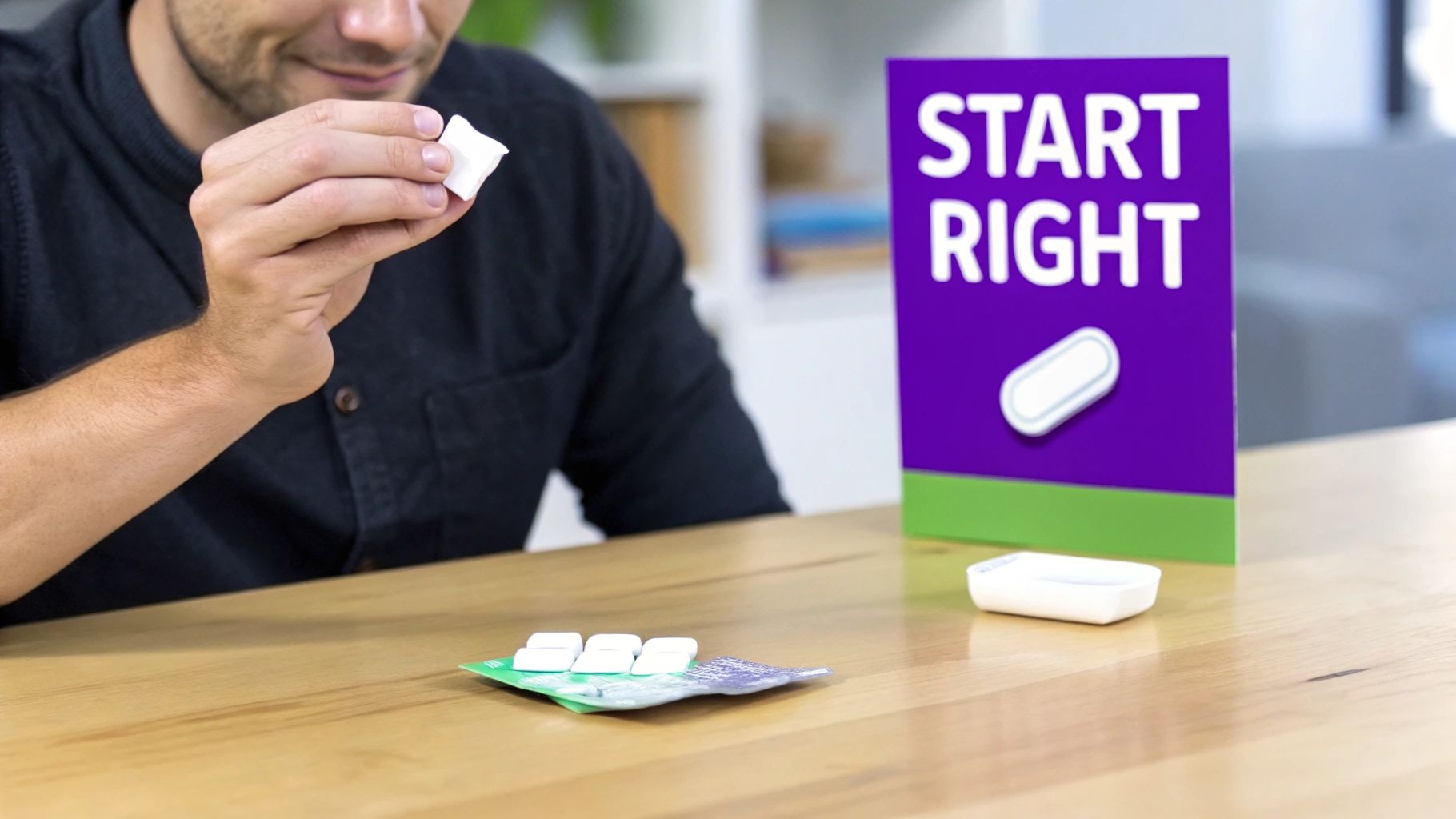
Don't Chew It Like Candy: The biggest mistake is chewing nicotine gum fast like regular gum. This causes hiccups and wastes the nicotine.
Master "Chew and Park": Chew slowly until you feel a tingle, then "park" the gum between your cheek and gum. Let it sit there until the tingle fades, then repeat. This is the secret to making it work.
Pick the Right Strength: If you smoke your first cigarette within 30 minutes of waking up, you need the 4mg strength. If you wait longer, start with the 2mg.
Schedule Your Doses: Don't wait for a craving to hit. Use a piece every 1-2 hours on a schedule, especially for the first six weeks.
Avoid Coffee & Soda: Acidic drinks like coffee, juice, or soda block nicotine absorption. Wait 15 minutes after drinking them before using the gum.
Getting It Right From Day One
Think of nicotine gum less like a treat and more like a tool designed for a specific job. The entire goal is to release nicotine slowly and steadily to keep cravings under control. If you chew it constantly, you'll release a flood of nicotine all at once, which your body can't absorb properly.
Here's the simple breakdown of the "chew and park" technique:
Chew the gum slowly until you notice a peppery taste or a slight tingling sensation. That's your signal the nicotine is being released.
Once you feel that tingle, stop chewing.
"Park" the gum between your cheek and gums.
Leave it there until the taste or tingle fades.
When it fades, chew it slowly a few more times to release more nicotine, then park it again.
Repeat this cycle for about 30 minutes or until the tingle is gone for good.
This method allows the nicotine to be absorbed gradually through the lining of your mouth. This is exactly what you want for steady, effective craving control.
Chew and Park vs. Chewing Like Candy
Mastering the 'chew and park' technique separates a successful experience from a frustrating one. To make it crystal clear, let's look at the two approaches side-by-side.
Nicotine Gum Technique At a Glance
This quick table shows you exactly what to do—and what to avoid.
Action
Correct Method (Chew & Park)
Incorrect Method (Continuous Chewing)
Pacing
Chew slowly a few times, then stop and rest the gum.
Chew quickly and constantly, like regular gum.
Absorption
Nicotine is absorbed slowly through the mouth's lining.
Nicotine is swallowed with saliva, leading to poor absorption.
Outcome
Cravings are steadily managed with minimal side effects.
Often results in hiccups, nausea, and ineffective craving relief.
Getting this right from the start prevents common side effects like heartburn and sore jaws. These issues make people think the gum isn't working for them. It is working—it just needs to be used the right way.
The fundamental mistake is treating nicotine gum like a snack instead of a tool. Proper nicotine gum usage is a deliberate process designed to deliver a controlled dose to manage withdrawal symptoms effectively.
Choosing the Right Nicotine Gum Strength
Your first big decision is picking the right dose, which sets the stage for everything that follows. Think of it like this: if you choose the wrong tool for a job, you're just making the work harder on yourself.
When it comes to nicotine gum, your choice between the standard 2 mg and 4 mg strengths boils down to one simple question about your smoking routine.
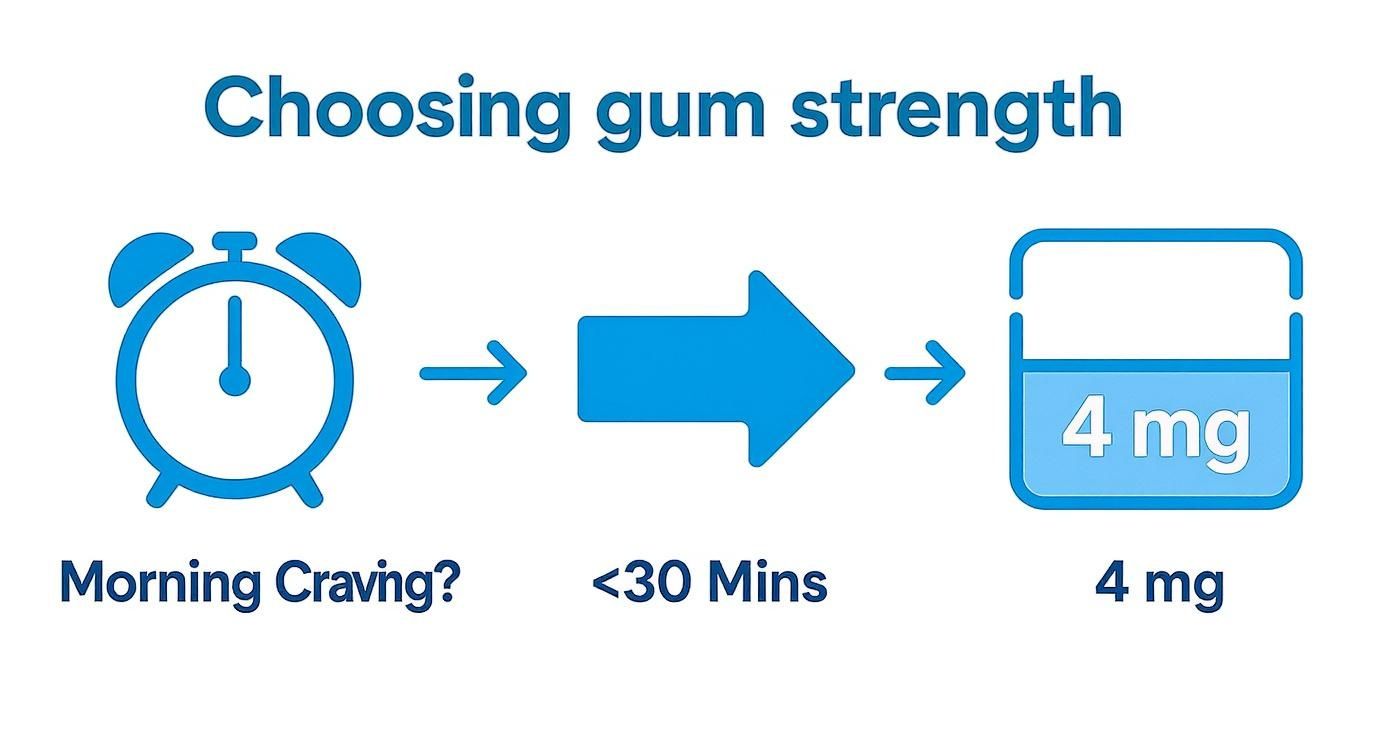
The answer to that question is a huge part of effective nicotine gum usage. If you reach for a cigarette within 30 minutes of waking up, the 4 mg gum is almost certainly where you need to start. That morning smoke is a classic sign of higher nicotine dependence, and a lower dose won't cut it.
Why Your Starting Strength Matters
Starting with the right strength is critical. Get it right, and you can sidestep nasty side effects from a dose that’s too high, or killer cravings from one that's too low. Too much nicotine can leave you feeling dizzy, but too little will have you frustrated and wanting to quit.
Choosing the right dose isn't a minor detail—it's the foundation of your quit plan. It’s about empowering you to make a smart, informed choice from the get-go.
While 2 mg and 4 mg are most common, some places offer other options. You might find strengths up to 6 mg, giving people more flexibility to match their old smoking habits. Doses above 3 mg are becoming more common as doctors prescribe them for heavy smokers.
If you're looking into other options, it helps to see how they stack up. To get a better sense of how different products compare, learn more in our detailed guide on nicotine patch strengths. Making a fully informed choice gives you the best possible shot at success.
Mastering the "Chew and Park" Method
If there's one secret to making nicotine gum work, this is it. It's called the "chew and park" method, and getting it right makes all the difference. Forget everything you know about chewing regular gum; this is a completely different ballgame.
The whole point is to release the nicotine slowly and let it absorb through the lining of your mouth, not your stomach. Chew it like candy, and you’ll end up with hiccups and a stomachache instead of craving relief.
The Rhythm of Relief: Chew, Tingle, Park
So, how does it actually work? It’s a simple, repeatable cycle.
Start by chewing the gum slowly, without rushing. After a few chews, you'll notice a distinct peppery taste or a slight tingling sensation. That tingle is your signal—it means the nicotine has been released.
Stop chewing immediately.
Now, "park" the gum by tucking it between your cheek and gums and just let it sit there. While parked, nicotine is gradually absorbed into your bloodstream. This provides steady, long-lasting craving control.
The "park" phase is where the magic happens. Chewing constantly floods your mouth with nicotine that you just end up swallowing. That leads to irritation, hiccups, and wasted gum. Patience is your best friend here.
After a while, you'll notice the tingle has faded. That's your cue to chew the gum a few more times until the sensation comes back, then park it again. Keep this chew-park-wait cycle going for about 30 minutes, which is how long one piece is effective.
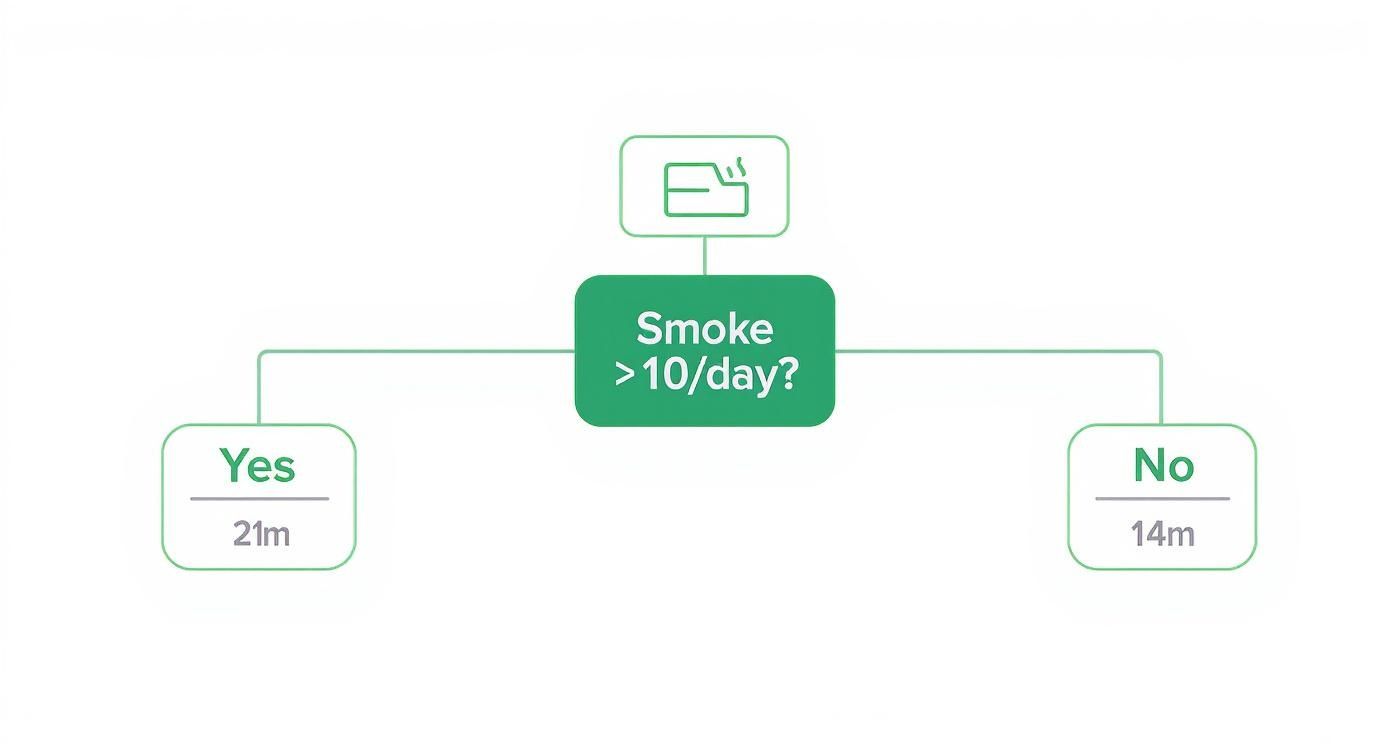
This infographic can help you figure out which strength to start with, based on when you have your first cigarette of the day.
As you can see, if you're reaching for a cigarette within 30 minutes of waking up, the 4 mg gum is probably the right choice. It helps manage those intense morning cravings effectively.
Why You Can’t Just Chew, Chew, Chew
When you chew nicotine gum too quickly, you’re basically doing it wrong. All that aggressive chewing creates a ton of nicotine-filled saliva. That saliva goes straight down into your stomach.
Your stomach acid is great at breaking down food, and it does the same to nicotine. This renders it useless for fighting cravings. The nicotine that isn't destroyed just ends up irritating your digestive system.
This is why so many people complain about the side effects:
Hiccups
Heartburn
Nausea and an upset stomach
Think of it this way: you're trying to give a delicate plant a drink of water. A gentle, slow drizzle works perfectly. Blasting it with a firehose just makes a mess. The "chew and park" method is that slow drizzle, giving your body the nicotine it needs.
Building Your Personal Dosing Schedule
Success with nicotine gum is all about timing. Map out a proactive schedule based on your personal craving triggers, rather than waiting for them to strike. A common plan is to use a piece every 1-2 hours for the first six weeks, then slowly dial it back.
Effective nicotine gum usage isn't just about how you chew, but when. Creating a consistent routine is your best defense against cravings. It keeps a steady, predictable level of nicotine in your system and helps you avoid sudden urges.
Think of it as getting ahead of the craving. If you always want a cigarette with your morning coffee, don’t wait for that urge to hit you. Plan on having a piece of gum 15 minutesbefore you even start the coffee maker.
Creating Your Initial Schedule
For the first six weeks, consistency is everything. Most people do best with a structured plan that looks something like this:
Frequency: Plan to chew one piece of gum every 1 to 2 hours.
Minimum Daily Use: Aim for at least 9 pieces per day to keep withdrawal symptoms at bay.
Maximum Daily Use: Do not exceed 24 pieces of 2 mg gum or 20 pieces of 4 mg gum in 24 hours.
Following a set schedule helps your body adjust to getting nicotine from a new, cleaner source. You can learn more about how long nicotine stays in your system through tobacco use testing.
Remember, the goal is to be proactive, not reactive. A well-planned schedule is like having a roadmap for your day, guiding you past craving hotspots before they become an issue.
The 12-Week Tapering Plan
After the first six weeks, it's time to start gradually reducing your dependence. This tapering phase is designed to be slow and steady. This helps you avoid shocking your system and triggering a relapse.
A standard plan provides a clear path. For weeks 7-9, you might cut back to one piece every 2-4 hours. From weeks 10-12, you'd reduce it further to one piece every 4-8 hours. This gradual step-down makes the process feel much more manageable.
Navigating Common Side Effects and Mistakes
Even when you think you have the technique down, a few common issues can still pop up. Don't worry, this is a normal part of figuring out what works best for you. Think of these hurdles as learning moments, not failures.
Most side effects—like hiccups, heartburn, or an aching jaw—almost always point to the same culprit: chewing too quickly. Thankfully, it's an easy fix. Just slow down, chew less, and "park" the gum for longer.
Why Your Morning Coffee Is a Problem
Another classic mistake involves what you're drinking. If you've ever used gum right after a coffee, juice, or soda and felt like it did nothing, you're not imagining things.
The high acidity in these drinks messes with the pH balance in your mouth. This change effectively blocks nicotine from being absorbed, making the gum pretty much useless.
It’s kind of like trying to light a damp match. The acid in your drink creates a "wet" environment in your mouth, and the nicotine just can't "spark" and get into your system.
To make sure you get the full effect from every piece, follow this simple rule:
Wait at least 15 minutes after you finish an acidic drink before using gum.
While you're actively using the gum, stick to plain water.
This one tiny adjustment can make a massive difference. Getting the physical side of quitting under control is crucial, but remember to keep an eye on the mental aspect, too. You can learn more by exploring if giving up smoking causes depression.
Got Questions About Nicotine Gum? We've Got Answers.
When you're trying to quit smoking, you're bound to have questions about the tools you're using. Let's tackle some of the most common things people ask about nicotine gum. This will help you use it with confidence.
How Long Does a Piece of Gum Last?
You can expect each piece of nicotine gum to last for about 30 minutes. But don't make the mistake of chewing it like regular gum for that whole time.
The trick is the "chew and park" method. Chew slowly until you feel a peppery taste or a slight tingle, then tuck the gum between your cheek and gums. When the tingle fades, chew it a few more times and park it again.
Can I Get Addicted to the Gum Itself?
It's a valid concern, but getting truly addicted to nicotine gum is pretty rare. The gum provides a slow, steady release of nicotine. Unlike the fast hit from a cigarette, this controlled delivery doesn't produce the same powerful rush that reinforces addiction.
Nicotine replacement therapy is a temporary tool with a clear exit strategy. The goal is to taper down and stop completely. It's a trusted method, which is why the global nicotine gum market has grown according to reports from firms like Persistence Market Research.
What if I Accidentally Swallow a Piece?
First off, don't panic. Swallowing a piece of nicotine gum isn't dangerous, but it does mean the nicotine in that piece will go to waste.
For the gum to work, the nicotine needs to be absorbed through the lining of your mouth. If you swallow it, your stomach acid will break down most of the nicotine before it ever reaches your bloodstream.
You might get a bit of an upset stomach or some hiccups, but that's about it. Just remember to use a fresh piece and stick to the "chew and park" technique next time.
At Nic Facts, our mission is to provide clear, evidence-based information to help you understand nicotine. We believe everyone deserves access to accurate, unbiased knowledge. Explore more at https://nicfacts.org.
TL;DR: Think of nicotine patch strengths like a volume knob for your cravings. You start at a level that matches how much you smoke, then you slowly turn it down over time. The most common strengths are 21mg, 14mg, and 7mg, which are designed to help you step down and quit gradually.
How to Choose the Right Nicotine Patch Strength
Picking the right starting dose for a nicotine patch is a huge part of setting yourself up for success. Getting it right helps you keep those tough withdrawal symptoms at bay. The system is designed to be intuitive, matching the patch's strength to your daily smoking habits.
The idea is simple but powerful. You replace the erratic, high-dose nicotine hits from cigarettes with a slow, steady stream from the patch. This gives your body the nicotine it craves without the tar, carbon monoxide, and thousands of other chemicals.
Finding Your Starting Point
So, where do you begin? It almost always comes down to one simple question: how many cigarettes do you smoke each day? Someone with a pack-a-day habit needs a much higher starting dose than someone who only smokes a few.
Here’s how the standard recommendations usually break down:
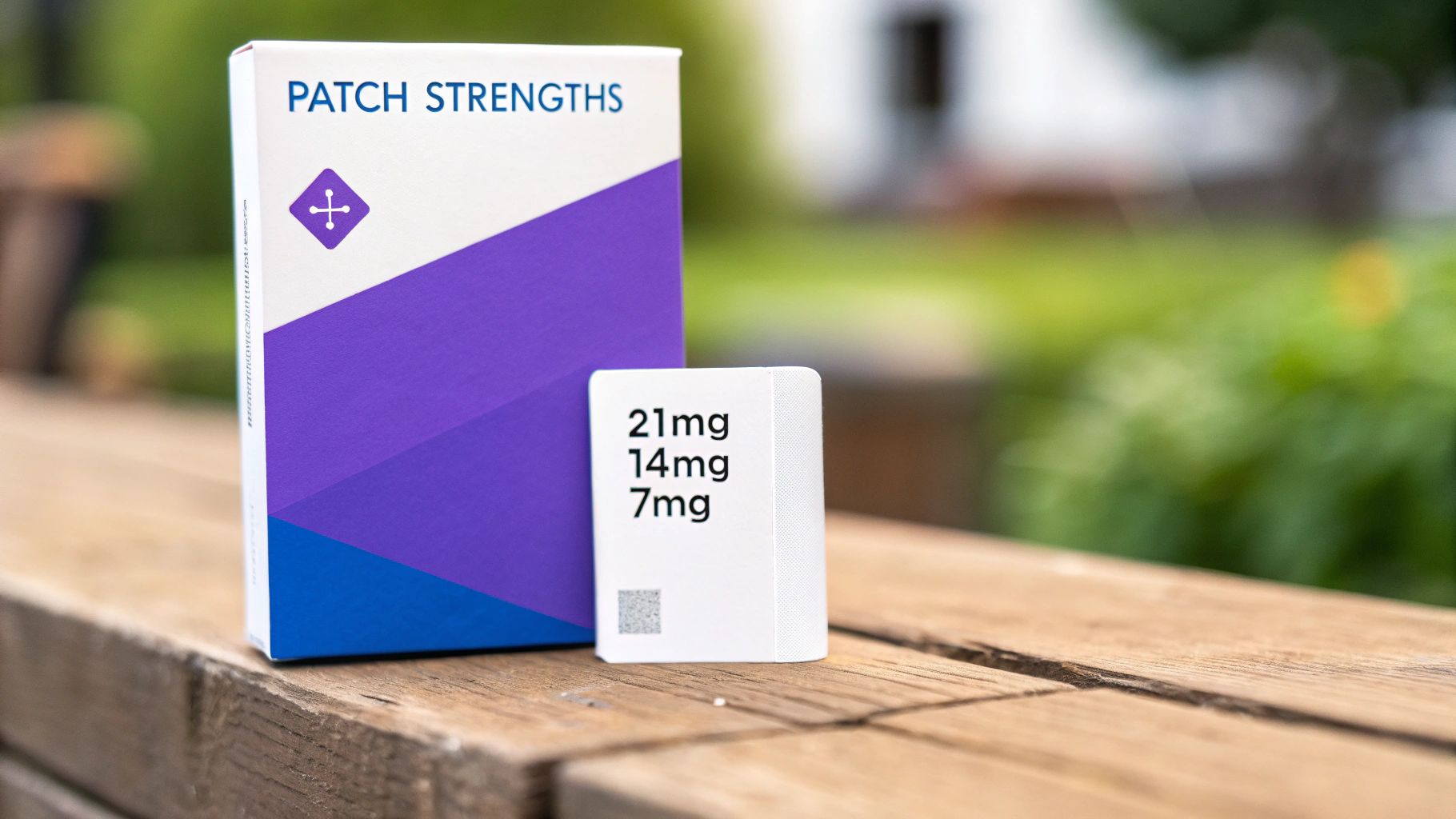
21mg Patch (Step 1): This is the highest dose and the typical starting point for anyone smoking more than 10 cigarettes a day. It's designed to handle the intense cravings that come with a heavier smoking habit.
14mg Patch (Step 2): If you smoke 10 or fewer cigarettes a day, this might be your starting point. It's also the second step for heavier smokers who are tapering down from the 21mg patch.
7mg Patch (Step 3): This is the finish line. The lowest dose helps your body make that final adjustment to being nicotine-free, making the last leap much easier.
This tiered system is what experts call the "step-down" method. You aren't just quitting cold turkey; you're gradually weaning your body and brain off nicotine. This gentle tapering process boosts your chances of staying smoke-free for good.
Nicotine Patch Strengths at a Glance
This table helps you match your daily smoking habit to the recommended starting patch strength and see a typical timeline for the step-down process.
Patch Strength (mg/24 hours)
Recommended For (Cigarettes per Day)
Typical Starting Step
Average Duration
21 mg
More than 10 cigarettes
Step 1
4-6 weeks
14 mg
10 or fewer cigarettes
Step 1 or 2
2-4 weeks
7 mg
Final tapering phase
Step 2 or 3
2-4 weeks
Remember, these are general guidelines. Your doctor or pharmacist can help you create a personalized plan that fits your needs. This ensures you have the best possible chance of success.
How Nicotine Patches Help You Quit
Think of a nicotine patch like a slow-drip irrigation system for your body. Instead of the sudden, intense rush from a cigarette, it delivers a steady, controlled stream of nicotine. This constant supply is the key to keeping withdrawal symptoms and cravings at bay.
Cigarettes deliver nicotine in sharp, fast spikes, creating a powerful cycle of craving and reward. The patch is designed to completely break that cycle by smoothing out those jarring peaks and valleys. This helps stop the irritability, anxiety, and cravings that often lead people back to smoking.
The patch is a cornerstone tool in many of the best smoking cessation methods used today.
The 24-Hour Patch vs. The 16-Hour Patch
One of the first choices you'll face is whether to get a patch you wear around the clock or one you take off at night. Each type is built for different kinds of smokers and cravings.
The 24-Hour Patch: You wear it continuously, day and night. It's fantastic for people who wake up in the morning already desperate for a cigarette. The patch keeps nicotine in your system overnight so you don't start your day in withdrawal.
The 16-Hour Patch: You wear this one only during your waking hours, taking it off before bed. This is a solid choice if the 24-hour patch gives you vivid dreams or disrupts your sleep.
Ultimately, the choice comes down to your daily experience. If that first-thing-in-the-morning cigarette is your biggest struggle, the 24-hour patch is probably your best bet.
The science behind either patch is a process called transdermal delivery. Nicotine is absorbed through your skin directly into the bloodstream. This method bypasses your lungs, meaning you get nicotine without the toxic tar from smoke.
Standardizing Strengths for Different Needs
The whole system works because patches come in different strengths, allowing you to match the dose to your level of dependency. Over the years, manufacturers have settled on a standard set of doses. This helps guide people through a gradual step-down process.
Most brands offer 24-hour patches in 7 mg, 14 mg, and 21 mg strengths. You'll also see corresponding doses for 16-hour patches, like 10 mg, 15 mg, and 25 mg, to fit that shorter wear time. This range ensures there’s a starting point that makes sense for you.
Choosing Your Starting Patch Strength
The short version? It all comes down to your daily smoking habit. If you're a pack-a-day person, you'll almost certainly start with the highest strength, 21 mg. Smoke 10 or fewer? The medium 14 mg patch is likely your best bet.
Picking the right nicotine patch strength is the foundation of your quit plan. Get it right, and you set yourself up for success. Too low a dose, and cravings will feel overwhelming; too high, and you might feel jittery.
The goal is simple: find a starting dose that takes the edge off withdrawal without giving you too much nicotine. Luckily, this isn't a shot in the dark. The patch system is designed to meet you where you are.
How Many Cigarettes Do You Smoke a Day?
Your daily cigarette count is the biggest clue for your starting strength. This number gives a direct snapshot of your body's current nicotine dependence. It's the most reliable way to match you with the right initial dose.
The concept is straightforward: the more you smoke, the more nicotine your body is used to. This means you'll need more help managing those intense withdrawal symptoms. That’s why the standard clinical guidelines are built around a simple threshold.
As a rule of thumb, if you smoke more than 10 cigarettes a day, you're what we consider a heavy smoker in the world of nicotine replacement. For this group, starting with the highest dose—the 21 mg patch—is the clear path forward.
If you smoke 10 or fewer cigarettes daily, your body’s nicotine demand is lower. Starting on the highest dose would likely be overkill. For lighter smokers, the 14 mg patch is the recommended starting point.
The "First Cigarette of the Day" Test
Here’s another incredibly useful tell: how soon do you light up after you wake up? This simple question reveals a ton about your physical addiction. It tells us how urgently your body craves nicotine just to get the day started.
Think about which of these sounds more like you:
You smoke within 30 minutes of opening your eyes. This is a classic sign of high nicotine dependence. After a whole night without it, your body is screaming for a fix.
You can wait an hour or more before your first cigarette. This suggests a lower level of physical dependence. Your morning cravings are still there, but they aren't quite as loud.
If you're in that first group, you should strongly consider the 21 mg patch. That intense morning craving is a dead giveaway that your body needs a strong, steady dose. It helps keep withdrawal from derailing your quit attempt right from the get-go.
The Step-Down Method: Your Guide to Tapering Off Nicotine
When it comes to quitting smoking, going "cold turkey" can feel like jumping off a cliff. The nicotine patch offers a much gentler approach: the "step-down" method. Think of it as walking down a staircase instead of taking a leap.
This systematic process is the secret sauce to making the patch work. You gradually lower your nicotine intake over several weeks. This gives your body and mind the time they need to adjust.
Your Step-Down Plan for Quitting
Quitting with a patch isn't about cutting off nicotine all at once. It’s a carefully planned tapering process that gently weans your body off its dependence. This prevents the shock to your system that often leads to relapse.
Each time you move to a lower patch strength—say, from 21 mg down to 14 mg—you're retraining your brain. You give it a few weeks to get used to functioning with less nicotine. This methodical reduction sets you up for long-term success.
A Typical Step-Down Schedule
While your doctor might adjust your plan, most nicotine patch programs follow a standard 8 to 12-week schedule. This timeline is broken into clear, manageable steps. It provides a predictable path forward, which can be incredibly reassuring.
Here’s what a common schedule looks like for someone who smokes more than 10 cigarettes a day:
Weeks 1-6 (Step 1): You’ll start with the 21 mg patch every day. This is the longest phase for a reason. It gives your body time to stabilize and helps you break the physical habit of smoking.
Weeks 7-8 (Step 2): Time to step down to the 14 mg patch. During these two weeks, you're teaching your body how to cope with a significantly lower level of nicotine.
Weeks 9-10 (Step 3): For the final stretch, you’ll use the 7 mg patch. This is the last taper, designed to gently guide you toward being completely nicotine-free.
This structured timeline is more than just a schedule; it’s a psychological roadmap. Knowing exactly what’s coming next helps build your confidence. It makes the whole process feel less daunting and much more achievable.
For lighter smokers (10 or fewer cigarettes a day), the journey is a bit shorter. They usually start at Step 2 with the 14 mg patch for six weeks. They then finish with the 7 mg patch for the last two weeks.
Managing Common Side Effects
Here's a quick rundown: most side effects are pretty mild and don't last long. Things like skin irritation or some wild dreams are common. You can usually handle them with simple tricks, like moving the patch to a new spot each day.
The vast majority of side effects are minor and easy to manage. It's just your body recalibrating to a life without cigarettes. Knowing what to expect makes it much easier to handle these little hurdles.
Dealing with Skin Irritation
The number one complaint is some redness, itching, or irritation right under the patch. This is almost always caused by the adhesive, not the nicotine. In fact, studies show that while mild skin reactions are common, they rarely lead people to give up.
Here are a few tried-and-true tricks to keep your skin happy:
Rotate, Rotate, Rotate: This is the most important rule. Never stick a new patch on the exact same spot two days in a row. Give each patch of skin at least a full week to breathe before you use it again.
Start with a Clean Slate: Always apply your patch to skin that's clean, dry, and free of any lotions or creams. This helps prevent irritation and makes the patch stick better.
Try a Different Brand: The adhesive formulas can vary quite a bit between brands. If one type consistently bugs your skin, switching to another can often solve the problem.
Navigating Sleep and Dreams
Using a 24-hour patch? You might notice some changes in your sleep. It's common for people to report having incredibly vivid or bizarre dreams. This happens because the patch keeps delivering nicotine overnight, which can keep your brain more active.
While it can be a bit strange, it’s not harmful. If the "dream theater" is getting to be too much, the easiest fix is to switch to a 16-hour patch. You could also talk to your doctor about trying a lower nicotine patch strength.
It's really important to know the difference between a minor side effect and the signs of too much nicotine. A little redness is one thing. Feeling dizzy, nauseous, or having a racing heartbeat is another. Remove the patch and contact your doctor if that happens.
Why Nicotine Patches Are a Global Health Tool
When you choose to use a nicotine patch, you're not just making a personal choice. You are joining a massive global health movement. Your decision contributes to a worldwide shift toward better public health.
Think of the patch as a standard item in a first-aid kit. It's a simple, effective, and widely available way to tackle a huge public health challenge. This is why organizations and governments champion nicotine replacement therapies (NRTs) like the patch.
The Growing Market for Quitting Aids
You can see this shift happening in real-time just by looking at the economics. The global nicotine patch market was valued at around USD 1.2 billion in 2023. It is expected to nearly double, hitting roughly USD 2.3 billion by 2032.
This isn't just about business; it’s a reflection of a deeper cultural change. The growth is fueled by government initiatives to cut smoking rates and public demand for quitting aids. More people than ever are actively looking for a way out of smoking.
This collective movement is about empowerment. It's about giving people the tools they need to reclaim their health. Your personal journey is a vital part of this positive, large-scale change.
A Tool for Mental and Physical Wellness
The benefits of quitting smoking go way beyond just your lungs. The connection between smoking and mental health is incredibly strong. Many smokers feel stuck in a cycle where addiction makes their anxiety and stress worse.
Nicotine patches help break that cycle. By providing a steady dose of nicotine, they help manage intense physical cravings. This stabilization can lead to significant improvements in your mood and well-being.
Once the physical side of addiction is under control, you free up energy to focus on building new, healthier habits. Understanding the effects of smoking on mental health can be a huge motivator. It highlights how much you stand to gain by choosing to quit.
Common Questions About Nicotine Patches
The bottom line: Don't slice your patch in half—it ruins how the nicotine is released. If you forget to put a new one on, just change it as soon as you remember. And definitely don't mix patches with other quit aids unless your doctor gives you the green light.
Even the best-laid plans come with a few questions. Let's tackle some of the most common uncertainties about using nicotine patches.
Can you just cut your nicotine patch in half? The short and simple answer is no. Cutting a patch compromises the engineered layers that ensure a slow, steady release of nicotine.
Think of it like a time-release capsule; if you crush it, you get the full dose at once. Cutting a patch destroys the control mechanism. This can lead to an unpredictable dose and make it harder to manage cravings.
Navigating Daily Use and Dosages
So, what if you forget to change your patch on schedule? It happens. Don't worry about it—just take off the old one and put on a new one as soon as you realize. Then get back to your normal daily routine.
Another question is about mixing patches with other quit-smoking products, like nicotine gum. This is where you absolutely must talk to a healthcare professional. Combining different NRTs without guidance can put you at risk of a nicotine overdose.
The point of stepping down through patch strengths is to gently wean your body off nicotine. If you add in other products without a clear medical strategy, you might keep your nicotine intake too high. This works against your own goal.
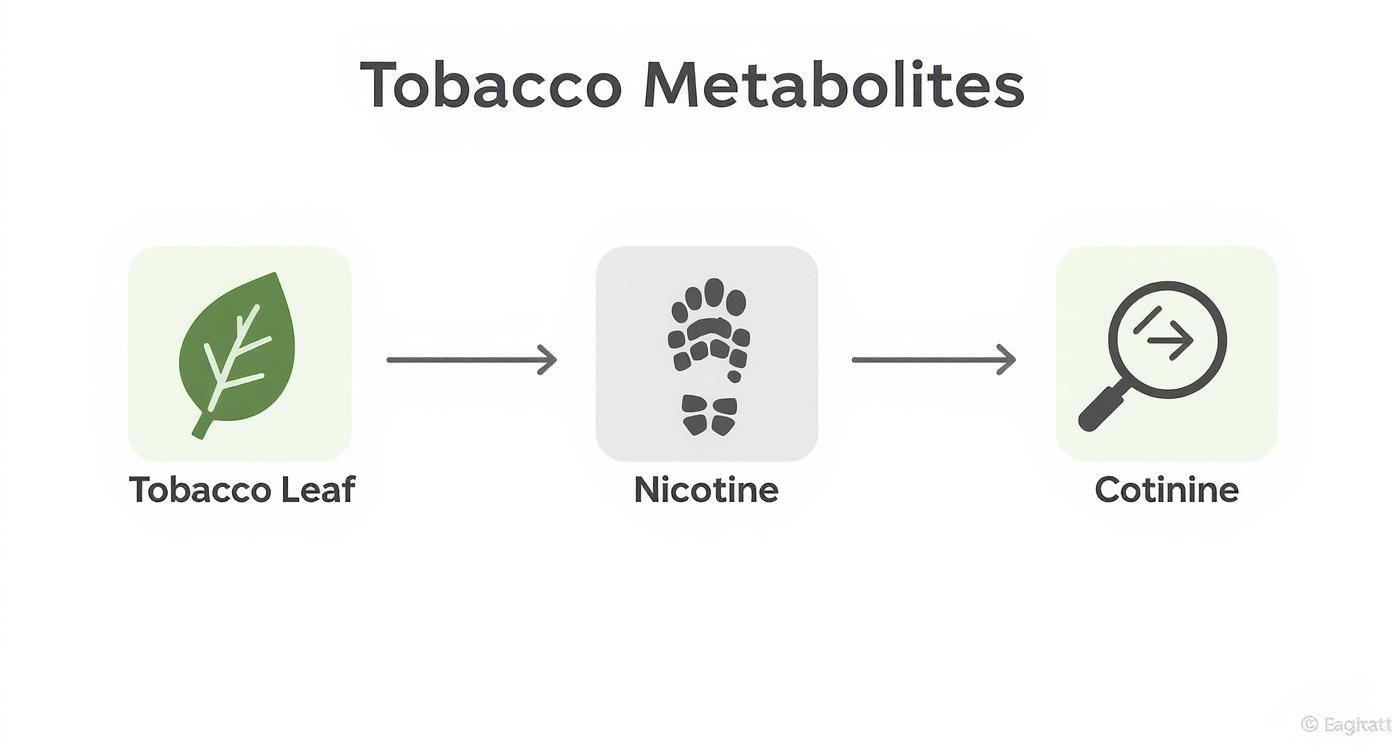
Finally, people sometimes ask how nicotine use is measured. Professionals can use methods for tobacco use testing to measure cotinine levels. Cotinine is what your body produces as it breaks down nicotine, so it's a reliable marker.
At Nic Facts, our mission is to provide clear, evidence-based information to help you understand nicotine. To learn more about the science behind it all, explore our resources at https://nicfacts.org.
TLDR: The Best Ways to Quit Smoking Quitting is a personal journey, not a one-size-fits-all race. The most successful methods often combine strategies:
Medical Aids: Nicotine Replacement Therapy (NRT) like patches or gum, and prescription pills (Varenicline, Bupropion) tackle physical cravings by managing your brain's chemistry. Think of them as a safety net that catches you during intense withdrawal.
Mental Game: Therapies like CBT help you rewire the habits and triggers linked to smoking. This is like training a muscle; you learn new ways to handle stress and boredom without reaching for a cigarette.
Support System: You don't have to go it alone. Counseling, support groups, and even quit-smoking apps provide accountability and the crucial reminder that you're not the only one fighting this battle.
The Golden Rule: Combining these approaches (e.g., using a patch while attending therapy) creates a powerful, multi-pronged attack on addiction and dramatically increases your chances of quitting for good.
Quitting smoking is one of the most significant steps you can take for your health. The journey often feels like navigating a dense, confusing forest. With countless options available, from patches and pills to therapy and alternative treatments, choosing the right path can be overwhelming.
This guide is designed to be your compass, cutting through the noise. It provides a clear, evidence-based overview of the best smoking cessation methods available today.
We understand that what works for one person may not work for another. That’s why this article avoids a one-size-fits-all approach. Instead, we present a roundup of ten distinct strategies, each backed by scientific research.
Throughout this guide, you will find practical, actionable advice for each method. We will explore everything from Nicotine Replacement Therapy (NRT) to behavioral approaches like Cognitive Behavioral Therapy (CBT). We will also cover combination therapy, support groups, and even the "cold turkey" approach.
Our goal is to empower you with knowledge. Understanding how each method works lets you build a personalized quit plan. This roadmap will equip you to make an informed decision and start your journey toward a healthier, smoke-free life.
1. Nicotine Replacement Therapy (NRT)
Nicotine Replacement Therapy (NRT) is one of the most widely recommended methods for quitting smoking. It operates on a simple principle: address the physical addiction separately from the psychological habit. NRT delivers controlled doses of nicotine without the thousands of other harmful chemicals in tobacco smoke.
Imagine trying to quit caffeine, smoking, and a sugar habit all on the same day—it's too much. NRT lets you tackle the smoking habit first by quieting the screaming demand for nicotine. This makes the mental battle much more winnable.
How NRT Works
Think of NRT as a nicotine "step-down" program. Using products like patches, gums, or lozenges satisfies your brain's demand for nicotine. This significantly reduces the severity of withdrawal.
The goal is to sever the link between the action of smoking and the nicotine reward. Over time, you follow a schedule to lower your NRT dosage, weaning your body off nicotine altogether. This is why NRT is considered one of the best smoking cessation methods.
Actionable Tips for Using NRT
To maximize your success with NRT, a strategic approach is key.
Combine Methods for Better Control: Many successful quitters use a long-acting patch for a steady nicotine level. They then use a short-acting product like gum or a lozenge to manage sudden, intense cravings.
Get the Dosage Right: Your starting dose should match your smoking habits. A heavy smoker will need a higher-dose patch than a light smoker.
Follow the Weaning Schedule: NRT products come with a clear step-down schedule, typically lasting 8-12 weeks. Sticking to this is vital to prevent transferring your dependence to the NRT product.
2. Prescription Medications (Varenicline and Bupropion)
For smokers who need a more powerful intervention, prescription medications offer a non-nicotine route to quitting. These FDA-approved drugs work within the brain to disrupt the cycle of nicotine addiction. They tackle the chemical side of dependence under medical supervision.
Think of these medications as a bouncer at a club in your brain. They either block nicotine from getting to the VIP receptors or they make the party less enjoyable. This makes cigarettes seem far less appealing.
How Prescription Medications Work
These medications rewire your brain's response to nicotine. Varenicline (Chantix) partially activates nicotine receptors. This both reduces withdrawal and blocks the pleasurable rush from cigarettes.
Bupropion (Zyban) is an antidepressant that also reduces nicotine cravings. Both are recognized as top smoking cessation methods. They directly address the neurological drivers of addiction.
Actionable Tips for Using Prescription Medications
Success with these medications hinges on proper use and medical guidance. They are powerful tools that require a specific approach.
Start Before You Stop: You typically begin taking these medications 1-2 weeks before your quit date. This allows the drug to build up in your system, so it's working when you have your last cigarette.
Combine with Behavioral Support: The medication handles the chemical battle, but you still need to break behavioral habits. Combining your prescription with counseling can significantly increase success.
Communicate with Your Doctor: Be honest with your healthcare provider about your medical history and any side effects. Consistent communication ensures your treatment is both safe and effective.
3. Cognitive Behavioral Therapy (CBT)
Cognitive Behavioral Therapy (CBT) tackles smoking cessation from a psychological angle. It operates on the idea that smoking is a learned behavior reinforced by specific thoughts and situations. CBT helps you identify these triggers and rewire your responses to them.
CBT is like being a detective of your own mind. You uncover the clues (triggers) that lead to the crime (smoking). Then, you create a new plan to avoid the crime altogether.
How CBT Works
Think of your smoking habit as a deeply ingrained script your brain runs. A stressful meeting ends, and the script says "time for a cigarette." CBT helps you rewrite that script.
A therapist works with you to uncover your unique triggers. Once identified, you develop a toolkit of alternative responses. By consistently applying these new behaviors, you dismantle the old associations.
This makes it one of the best smoking cessation methods for tackling psychological addiction. The connection between smoking and mental health is strong, and CBT provides tools to manage both. Learn more about smoking's effects on mental health here.
Actionable Tips for Using CBT
To get the most out of CBT, active participation is essential. It's a collaborative process between you and your therapist.
Start a Smoking Diary: Before you quit, log every cigarette. Note the time, place, and your mood. This data is invaluable for pinpointing your personal triggers.
Practice Coping Strategies Early: Don't wait until a massive craving hits. Practice your coping skills, like mindfulness, in low-stress situations first.
Set Specific, Measurable Goals: Work with your therapist to set concrete goals. For example, "When I feel stressed after work, I will walk around the block twice instead of smoking."
4. Combination Therapy (Multi-Modal Approach)
Combination Therapy supercharges your quit attempt by tackling addiction from all angles. It understands that smoking is a complex problem with physical, psychological, and behavioral components. Using multiple strategies at once creates a powerful, synergistic effect.
This approach is like assembling a team of superheroes to fight a villain. One hero is good, but a full team with different powers is unstoppable. Each therapy method targets a different weakness of the addiction.
How Combination Therapy Works
Think of quitting smoking like defeating a multi-headed monster. A nicotine patch (NRT) manages baseline physical cravings. Meanwhile, behavioral counseling helps you develop new coping mechanisms for stress.
This integrated strategy is one of the best smoking cessation methods because it leaves no stone unturned. The NHS often recommends combining a long-acting patch, a short-acting NRT product, and behavioral support. This multi-pronged attack makes relapse far less likely.
Actionable Tips for Using Combination Therapy
A successful combination plan is a personalized one. It requires careful planning and commitment.
Design a Plan with a Professional: Don't mix and match methods on your own. Work with a doctor to create a personalized plan that combines the right tools for your specific needs.
Synchronize Your Start: Begin all components of your plan around the same quit date. This creates a strong, unified front against nicotine from day one.
Leverage Digital Support: Incorporate technology into your approach. Explore the best quit smoking apps to track progress, manage cravings, and connect with a community.
5. Behavioral Counseling and Support Groups
Quitting smoking isn't just a physical battle; it's a profound psychological challenge. Behavioral Counseling and Support Groups tackle this head-on. They provide guidance, accountability, and the power of shared experience.
This method addresses the "why" you smoke, not just the "what." It's like having a team of coaches and cheerleaders. They give you the game plan and root for you when things get tough.
How Counseling and Support Works
Professional counselors help you identify your personal smoking triggers. They help you develop concrete strategies to manage them without a cigarette. This makes it one of the best methods for tackling the root causes of the habit.
Support groups, like Nicotine Anonymous, operate on the principle that "we are stronger together." Sharing struggles and celebrating victories with others on the same path creates a powerful sense of community. This reduces feelings of isolation that can lead to relapse.
Actionable Tips for Using Counseling and Support
Active participation is the key to unlocking the full potential of this method.
Combine with Other Methods: Behavioral support is incredibly effective when paired with NRT or prescription medication. One manages physical cravings while the other helps you dismantle the psychological addiction.
Find Your Fit: Not every group is right for every person. Explore options like the 12-step program of Nicotine Anonymous, telephone quitlines, or online forums.
Engage Actively: Don't just be a passive listener. Share your experiences, ask for advice, and offer support to others.
6. Mindfulness and Meditation-Based Interventions
Mindfulness and meditation are a newer, yet effective, approach to quitting smoking. This method targets the psychological triggers that drive the habit. It operates on the principle of awareness, teaching you to observe cravings without reacting.
It's like learning to surf. You can't stop the waves (cravings) from coming. But you can learn to ride them gracefully until they pass, instead of letting them crash over you.
How Mindfulness Works
Think of your smoking habit as a program running on autopilot. A trigger appears, and the program automatically runs: "light a cigarette." Mindfulness acts as a manual override, giving you a pause between the trigger and the action.
Through practices like mindful breathing, you learn to notice a craving as just a sensation, not a command. Studies have shown mindfulness can be more effective than standard treatments. This makes it a powerful mental tool among the best smoking cessation methods.
Actionable Tips for Using Mindfulness
Integrating mindfulness isn't about emptying your mind; it's about becoming more aware.
Start Small and Before Your Quit Date: Begin practicing with guided meditations for just 5-10 minutes a day. Apps like Headspace or Calm often have specific quit-smoking programs.
Notice Cravings Non-Judgmentally: When a craving hits, don't fight it. Simply acknowledge it: "Ah, there is a craving to smoke." Observe how it feels and watch it rise and fall like a wave.
Combine With Other Methods: Mindfulness works exceptionally well when paired with other methods like NRT. This gives you both a physical and mental toolkit to succeed.
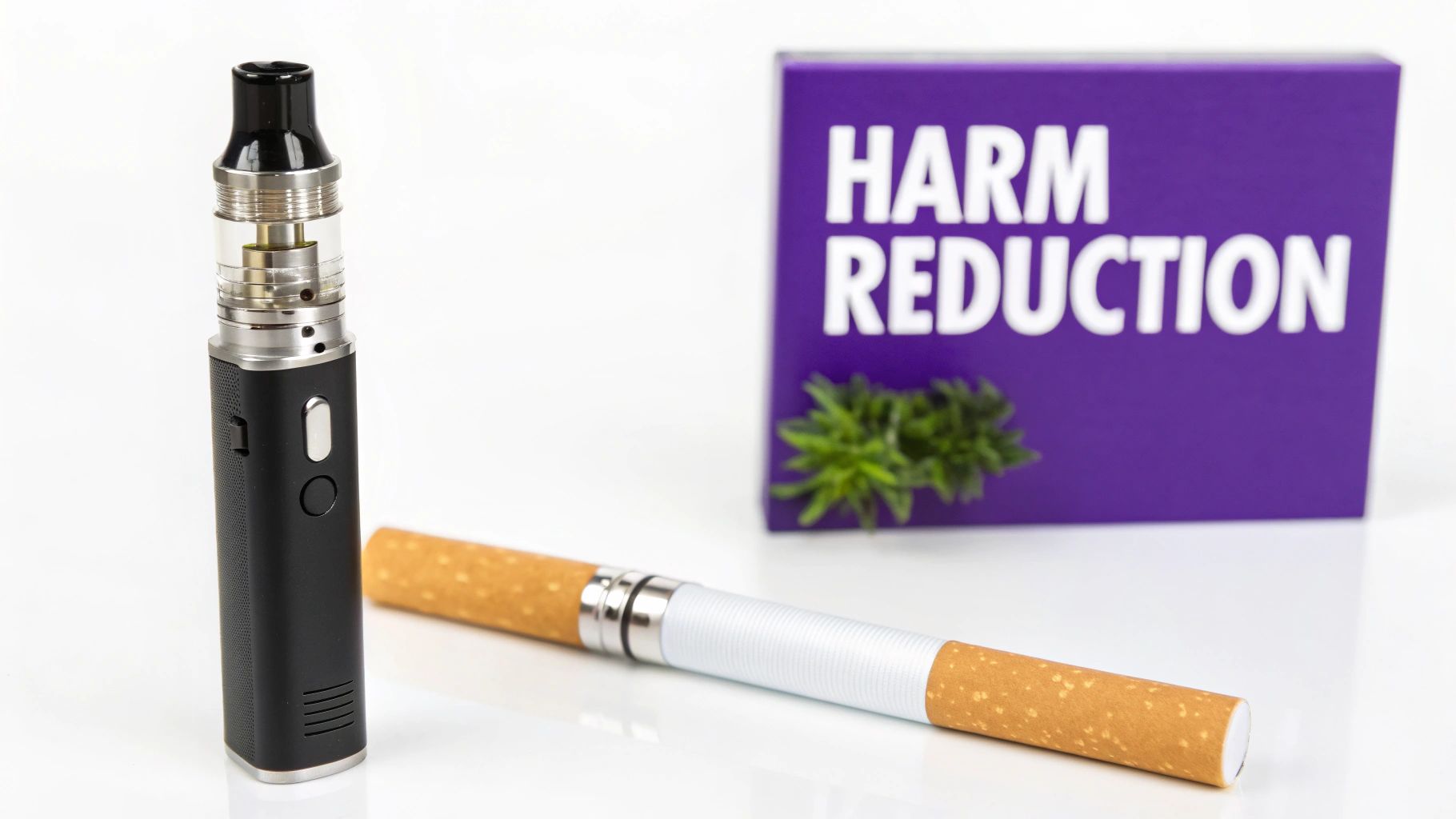
7. E-Cigarettes and Vaping as Harm Reduction
E-cigarettes, or vapes, are a controversial tool in smoking cessation. This method operates on a harm reduction principle. It replaces inhaling burning tobacco with a less harmful, though not risk-free, alternative.
Vaping is like taking a bridge instead of trying to swim across a dangerous river. The bridge isn't the final destination, but it's a much safer way to get to the other side. The goal is to eventually get off the bridge, too.
How E-Cigarettes Work for Cessation
The core idea is to substitute the habit. Vaping mimics the hand-to-mouth action and sensation of inhaling. This addresses both physical and behavioral components of the addiction.
A smoker can switch completely to vaping, severing their relationship with combustible tobacco. From there, the user can gradually taper their nicotine strength. The ultimate goal is to decrease the nicotine to zero and stop vaping altogether.
Actionable Tips for Using E-Cigarettes
Successfully using vaping to quit requires a deliberate plan, not just a simple swap.
Set a Clear End Date: Treat vaping as a transitional phase. Before you start, decide on a timeline (e.g., 3-6 months) for quitting all nicotine products.
Create a Tapering Schedule: Don't get stuck on a high nicotine level. Methodically step down the nicotine strength in your e-liquid every few weeks until you reach 0mg.
Choose Quality Products: Not all devices are created equal. Research reputable brands and purchase from trusted vendors to ensure you are not inhaling harmful additives.
8. Motivational Interviewing and Readiness Assessment
Motivational Interviewing (MI) is a counseling style designed to strengthen your own motivation to change. Instead of telling you why you should quit, a counselor helps you explore your own ambivalence. It's a guided conversation that helps you find your "why" from within.
This process is like having a guide help you find a hidden treasure map inside yourself. The guide doesn't tell you where the treasure is. They just help you read the map you already had.
How MI Works
Motivational Interviewing is a partnership rather than a lecture. The counselor acts as a guide, asking open-ended questions. This encourages you to articulate why you want to change and how you might do it.
This process helps you weigh the pros and cons of smoking in your own life. It strengthens your resolve. This personalized approach makes it one of the best methods for building a durable foundation for change.
Actionable Tips for Using MI
You can apply MI principles yourself to build readiness before your quit attempt.
Explore Your Ambivalence: On paper, create two columns: "What I like about smoking" and "What I don't." Seeing the conflict can clarify your motivations.
Identify Your 'Why': What is the single most important reason you want to quit? Write it down and place it somewhere you'll see it every day.
Envision Your Future: Spend a few minutes each day imagining your life as a non-smoker. Focus on the positive changes.
9. Acupuncture and Alternative Therapies
Acupuncture and other alternative therapies offer a holistic approach to quitting smoking. They focus on restoring the body's natural balance, which is believed to be disrupted by nicotine addiction. Many individuals report benefits in managing withdrawal and cravings.
Think of your body's energy pathways like a traffic jam caused by addiction. Acupuncture acts like a traffic controller, clearing the blockages. This helps everything flow smoothly again, reducing the stress and irritation of the jam.
How Acupuncture Works for Quitting
Acupuncture involves inserting ultra-thin needles into specific points (acupoints). This is thought to reduce cravings, calm irritability, and lessen anxiety. The process helps restore proper energy flow.
Auricular acupuncture, which focuses on points in the ear, is popular for addiction treatment. The goal is to stimulate the release of endorphins, the body's natural "feel-good" chemicals. This can help offset the dopamine crash during nicotine withdrawal.
Actionable Tips for Using Alternative Therapies
Approach these complementary methods with a clear strategy and realistic expectations.
Find a Qualified Practitioner: Your practitioner’s expertise matters. Look for a licensed acupuncturist (L.Ac.) with specific experience in addiction and smoking cessation.
Combine with Behavioral Support: Use acupuncture to manage physical withdrawal symptoms. At the same time, work on breaking psychological habits through counseling or a support group.
Be Realistic and Patient: The effects may be subtle or cumulative. Commit to a full course of treatment as recommended by your practitioner.
10. Cold Turkey (Abrupt Cessation) with Preparation
The "cold turkey" method involves stopping smoking abruptly, without NRT or medication. While difficult, this all-or-nothing approach can be effective for some. This is especially true when it's a well-prepared, strategic plan.
Going cold turkey is like ripping off a bandage. It's intense and painful for a short period. But for some, it's better than the slow, prolonged discomfort of peeling it off bit by bit.
How Cold Turkey Works
This method bypasses the weaning process and directly confronts the addiction at once. The core idea is to make a clean break. For some, the finality of this decision is a powerful motivator.
Success hinges almost entirely on mental fortitude and a robust support structure. Without preparation, spontaneous attempts often fail due to the intensity of withdrawal. A planned approach transforms it into one of the most empowering smoking cessation methods for the right person.
Actionable Tips for a Prepared Cold Turkey Quit
Quitting cold turkey isn't just about throwing your cigarettes away. It's about building a fortress of support and strategy first.
Create a "Quit Day" Plan: Set a firm date and prepare for it. Clean your house and car to remove the smell of smoke, and dispose of all smoking paraphernalia.
Build Your Support Network: Inform friends and family of your plan and ask for their support. Join a support group, either online or in-person.
Plan for Cravings: The first 72 hours are typically the most intense. Plan activities to distract yourself and have a go-to person you can call. Consider getting tested; seeing nicotine leave your system can be a huge motivator. You can learn more about tobacco use testing here.
No medication costs or dependency transfer; rapid nicotine elimination
Designing Your Personal Quit Plan: The Path Forward
Quitting smoking is one of the most rewarding decisions you can make. We've explored the best smoking cessation methods, from medical interventions to psychological strategies. The path to a smoke-free life is a personalized journey, not a one-size-fits-all road.
The key takeaway is this: synergy is your greatest asset. While any single method can increase your chances, combining them creates a far more robust strategy. Think of it as building a support structure; a network of supports is much harder to topple.
Synthesizing the Strategies for Maximum Impact
The most effective quit plans integrate elements from multiple categories. This creates a holistic approach that addresses the physical, psychological, and behavioral facets of addiction.
Address the Physical: NRT and prescription medications ease the neurochemical storm in your brain. This gives you the stability to focus on behavioral changes.
Rewire the Psychological: CBT is your toolkit for deconstructing habits and emotions linked to smoking. It helps you develop new, healthier coping mechanisms.
Build a Support System: You don't have to navigate this path alone. Counseling and support groups provide accountability, empathy, and motivation.
Key Insight: Your quit plan is a living document, not a rigid contract. The ability to adapt is crucial. Be prepared to reassess and modify your approach.
Actionable Next Steps: Building Your Blueprint
Information is only powerful when put into action. Here is a step-by-step approach to designing your personal quit plan.
Consult a Professional: Your first step is to speak with a healthcare provider. They can assess your health and help you choose the right medical aids.
Conduct a "Smoking Audit": Before your quit date, track your smoking habits. This audit will reveal your personal high-risk triggers.
Create a Combination Strategy: Select a primary method and at least one supporting method. A powerful combination could be a nicotine patch, CBT sessions, and a support buddy.
Set a Quit Date and Prepare: Choose a specific date. Prepare your environment by removing all smoking paraphernalia and stocking up on healthy snacks.
Mastering these concepts is about reclaiming your health, finances, and freedom. Each day without a cigarette is a victory. This journey is a profound investment in your future self, and you can successfully complete it.
For a deeper, evidence-based understanding of nicotine's effects and the science behind quitting, explore the resources at Nic Facts. Our mission is to provide clear, unbiased information to empower you on your journey to a healthier life. Find comprehensive guides and data-driven insights at Nic Facts.
TL;DR: Kicking the smoking habit is tough, but the right app is a powerful ally. This guide helps you find the best quit smoking apps for your needs, whether you prefer data-driven trackers, mindset-shifting programs, or community support platforms. We review each app's unique approach, so you can pick your digital partner and start your smoke-free journey with confidence.
Quitting smoking is a deeply personal journey, and the tool you choose can make all the difference. Think of it like a fitness goal. Some people thrive with a personal coach, others prefer a detailed workout plan, and some just need a supportive group to cheer them on. The digital world offers the same variety of support for quitting nicotine.
This guide is your personal consultant, helping you navigate the crowded app store to find your perfect match. We dive deep into what makes each application effective for different types of people. You will find a detailed breakdown of 12 leading quit-smoking resources, from data-rich trackers to evidence-based behavioral programs.
Our goal is to eliminate the guesswork. For each app, you get an honest look at its core philosophy, usability, and scientific backing. Complete with screenshots and direct links, this resource provides everything you need to choose with confidence and take a decisive step toward a healthier, smoke-free life.
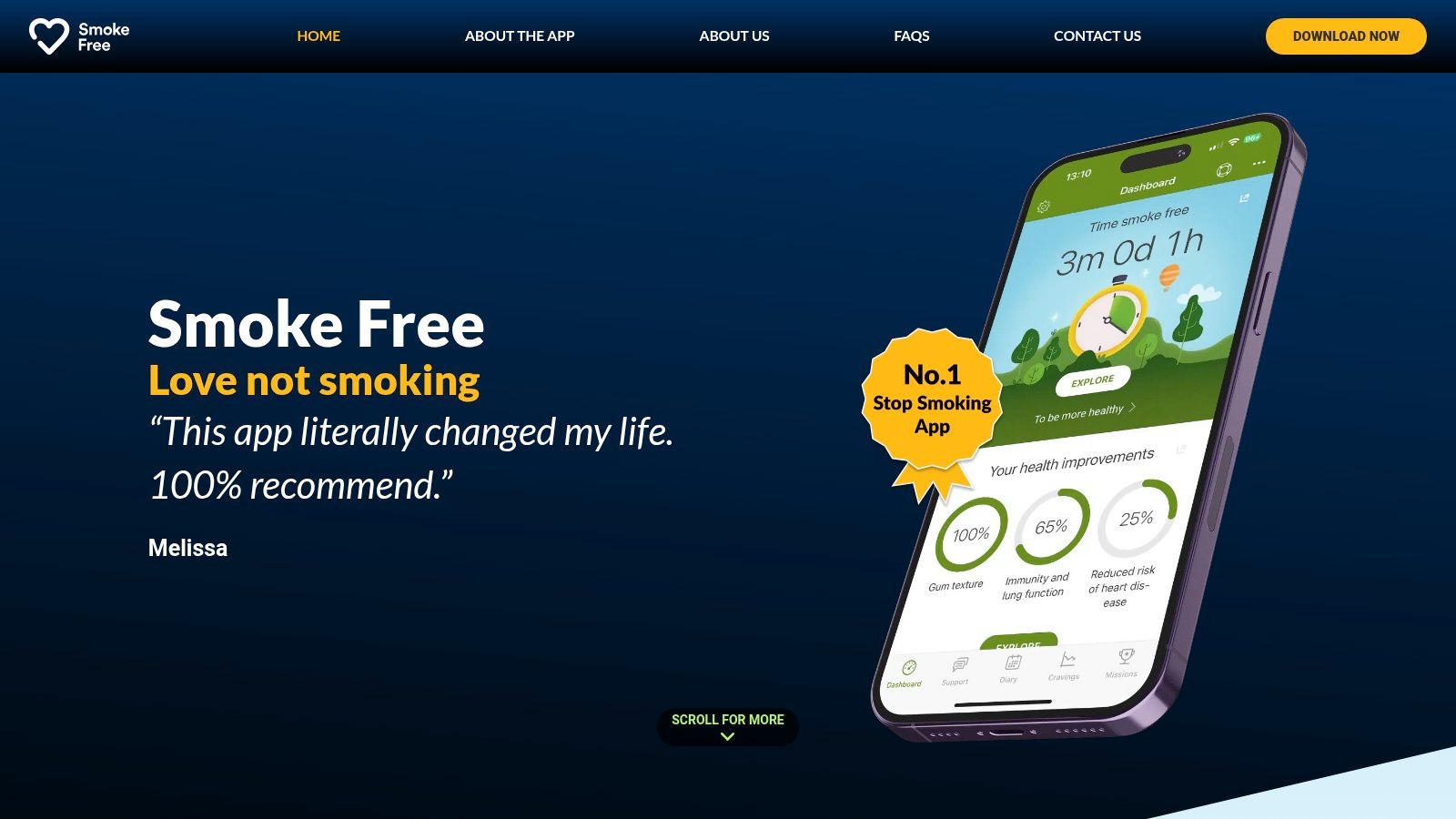
1. Smoke Free
Smoke Free offers a robust, evidence-based approach, making it one of the best quit smoking apps for users who value scientific credibility. It's less of a simple tracker and more of a structured program. The platform is built on principles of cognitive-behavioral therapy (CBT) and has been validated by several studies.
Key Features and User Experience
Smoke Free guides you through daily "missions" that break the quitting process into manageable steps. This gamified approach helps build momentum and provides a clear sense of progress. A standout feature is the AI-powered Quit Coach chatbot, offering 24/7 support for managing cravings.
For users needing personalized guidance, premium tiers unlock live chat with human advisors. The app's dashboard is incredibly detailed, providing stats on money saved, health improvements, and craving patterns. This data-rich feedback reinforces the tangible benefits of your efforts.
Practical Considerations
The app is available on both iOS and Android with a robust free version. The free version includes the craving tracker, diary, and basic missions. To unlock the full suite of features, a subscription is required.
Pros & Cons
Pros
Cons
Strong Scientific Backing: Grounded in research and proven methods.
Paywalled Features: The most effective tools require a subscription.
Active Community: Large user base provides peer support and encouragement.
Europe-Centric: Some regulatory notes and services are geared toward a European audience.
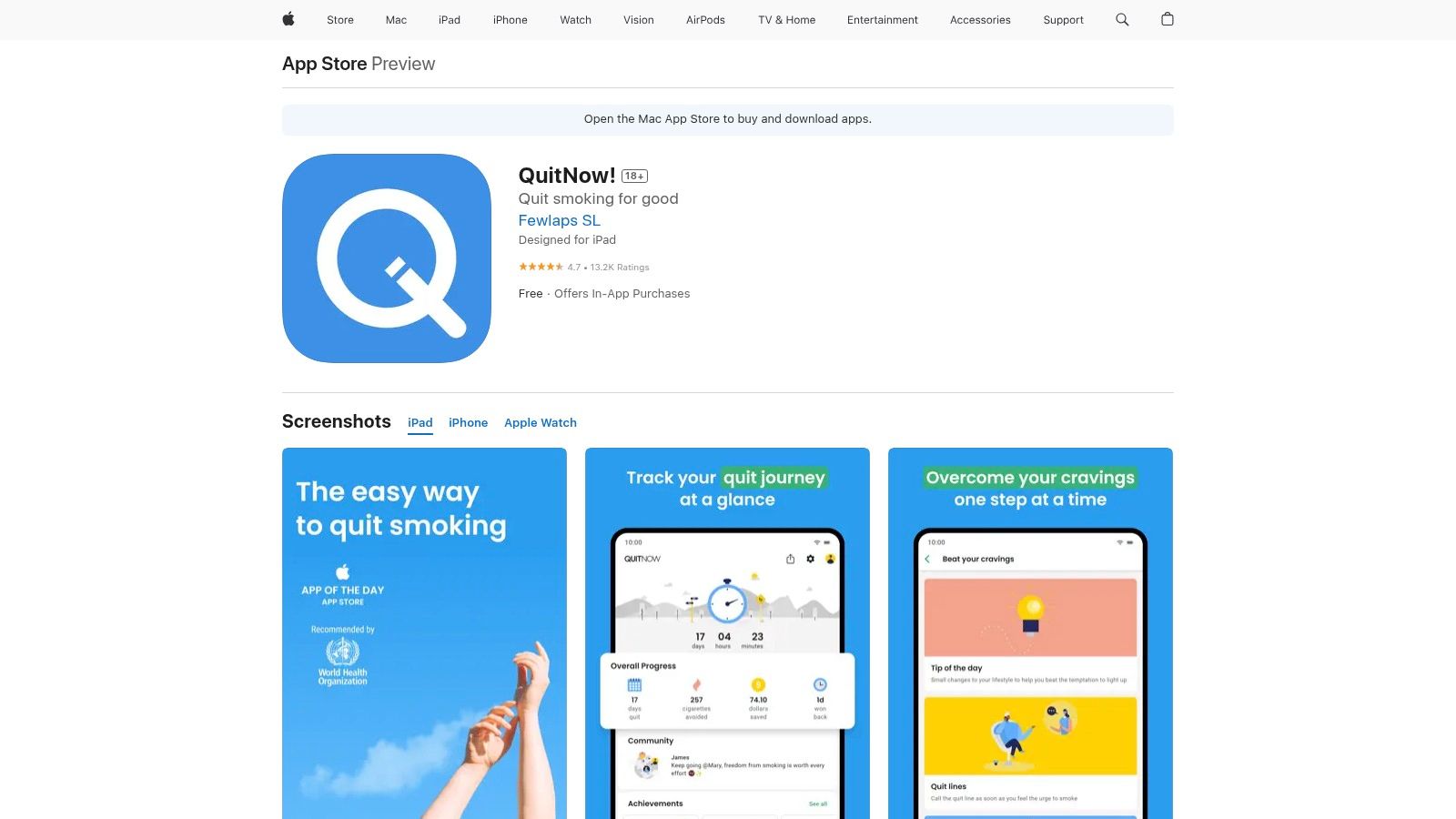
QuitNow! excels by focusing on the power of community, making it one of the best quit smoking apps for those who find motivation in shared experience. It frames quitting as a collective effort, emphasizing peer support and social accountability. The app is built on the idea that seeing others succeed is a powerful catalyst for change.
Key Features and User Experience
The core of QuitNow! is its always-on community chat, where users can connect with thousands of current and former smokers. This live chat provides immediate encouragement during a craving or a moment of weakness. The app also uses gamification to keep you engaged, offering over 70 unlockable achievements.
Its dashboard is clean and motivating, tracking key metrics like cigarettes avoided and money saved. A standout element is its set of health indicators based on World Health Organization (WHO) data. These show you the tangible health benefits you’re experiencing as you progress.
Practical Considerations
QuitNow! is available for both iOS and Android. A solid free version provides access to the core tracking features and community. The "PRO" version, accessible via a one-time purchase, unlocks advanced features and a personalized quit-bot.
Pros & Cons
Pros
Cons
Active Peer Support: The live chat community is highly praised and very active.
Paywalled Features: Several key achievements and tools require the PRO upgrade.
Clear Progress Visualizations: WHO-based health milestones are a great motivator.
Health Timeline Critiques: Some users question the accuracy or timing of the health milestones.
Frequently Updated: The app receives regular updates for stability and new features.
Best For: Individuals who thrive on social support and want a straightforward tracker powered by a vibrant, encouraging community.
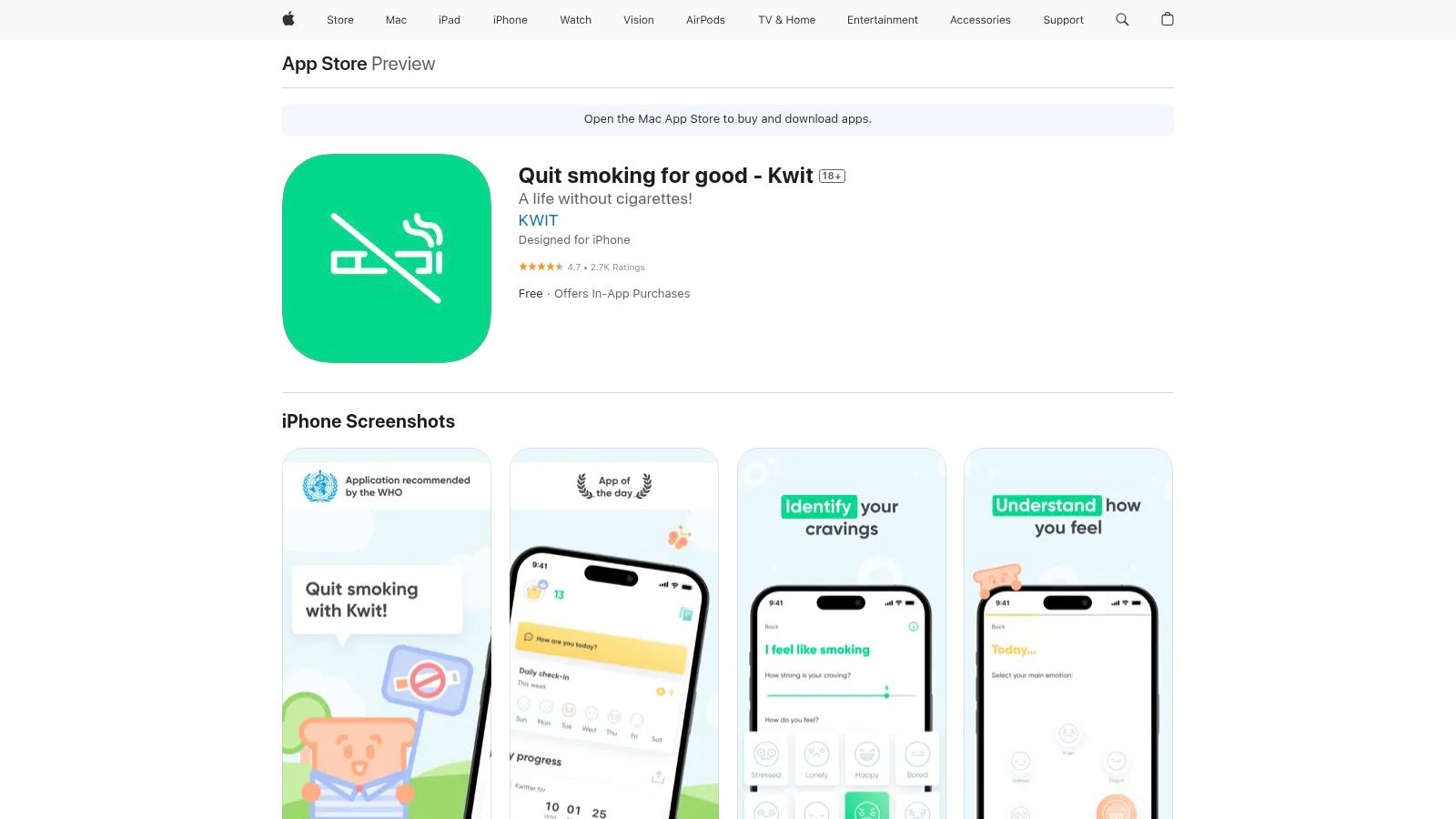
Kwit transforms the daunting task of quitting into an engaging, game-like experience. It uses Cognitive Behavioral Therapy (CBT) and gamification to motivate users. This approach, validated by the World Health Organization (WHO), keeps users engaged through positive reinforcement.
Key Features and User Experience
Kwit's standout feature is its 9-day structured preparation plan, which helps users prepare before their quit date. For managing cravings, the app offers interactive tools like breathing exercises and mini-games. As you progress, you unlock achievements and motivational cards.
The app provides detailed real-time stats, tracking everything from money saved to health improvements. A unique aspect is its dedicated support for users tapering with Nicotine Replacement Therapy (NRT). This allows them to track usage and gradually reduce dependence.
Practical Considerations
Kwit is available for both iOS and Android users. A functional free version provides access to the basic tracker and some motivational content. To access the full suite of features, users must subscribe to Kwit Premium.
Pros & Cons
Pros
Cons
Engaging, Game-Like Design: Gamification makes the quitting process more approachable.
Paywalled Features: Many core capabilities require a premium subscription.
Supports NRT Tapering: Excellent for users who are also using nicotine replacement products.
Tone Isn't for Everyone: Some users may find the app's prompts or motivational style not to their taste.
Structured Preparation: The 9-day prep plan helps users build a solid foundation before quitting.
Best For: Individuals who are motivated by gamification and achievement-based goals, especially those who plan to use Nicotine Replacement Therapy as part of their quit strategy.
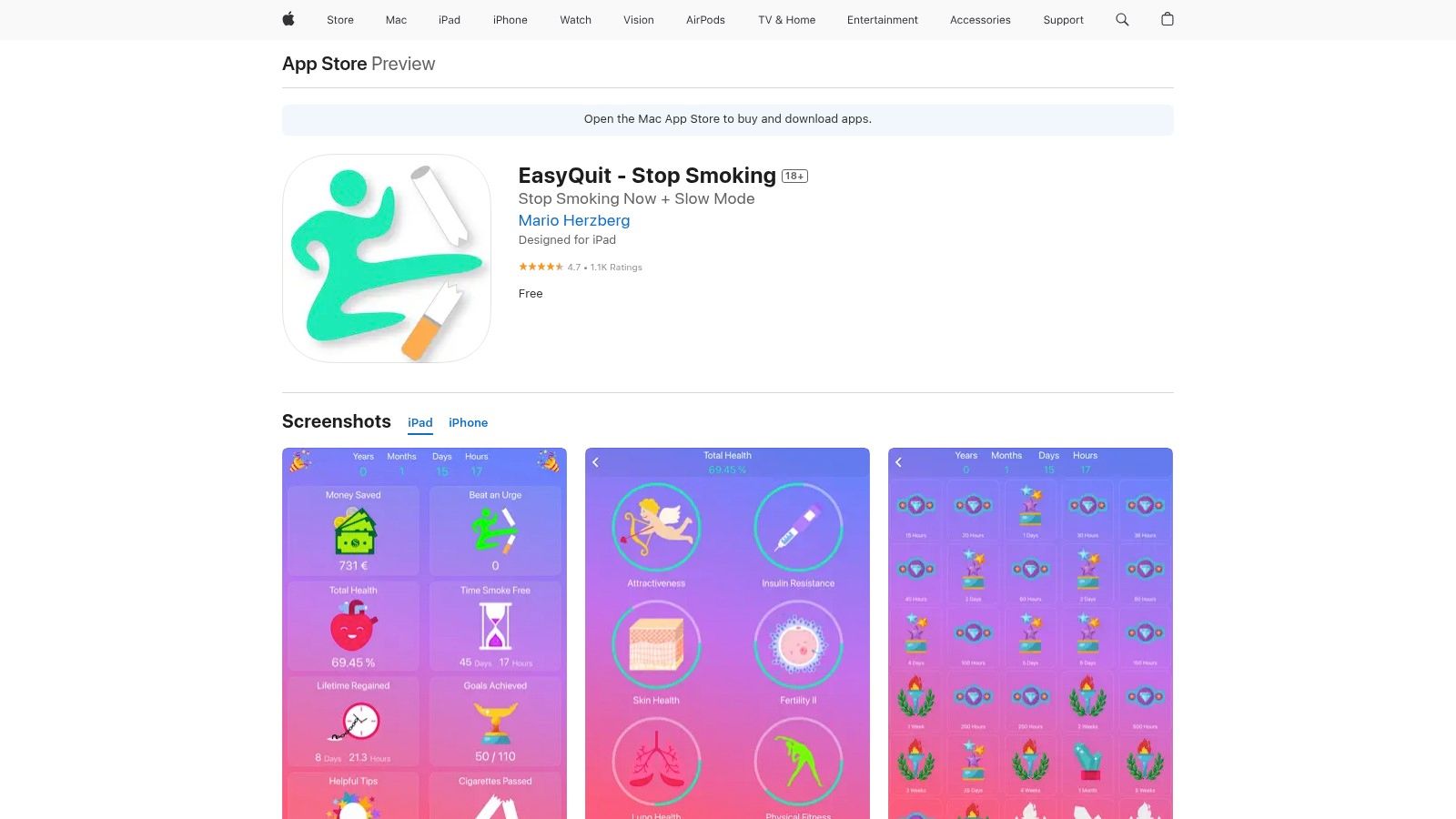
EasyQuit – Stop Smoking offers a different path for those who find the cold-turkey method daunting. It champions flexibility and user privacy. The app’s standout "Stop Slowly" mode helps users taper off their nicotine intake, which can be more manageable.
Key Features and User Experience
EasyQuit’s core feature is its gradual reduction plan, helping you decrease the number of cigarettes smoked daily. This method lessens the severity of withdrawal symptoms for many users. The app’s interface is straightforward, focusing on key metrics and health improvements.
A key differentiator is its commitment to privacy; the app requires no login. It also includes motivational badges and a helpful relapse assistant. These features combine to create a supportive, private, and less intimidating quitting environment.
Practical Considerations
EasyQuit is available on both iOS and Android. The free version provides access to the main trackers and the "Stop Slowly" mode. A one-time purchase unlocks the Pro version, which removes ads and adds features like home screen widgets.
Pros & Cons
Pros
Cons
No Sign-In Required: Data stays local and private on your device.
Basic UX: The design and user experience are less polished than premium apps.
Gradual Tapering Option: Ideal for users who want to reduce slowly.
Gated Pro Features: Widgets and other customizations require a one-time payment.
Customizable Widgets: Keep your motivation visible on your home screen.
Best For: Privacy-conscious users and those who believe a gradual, tapering approach to quitting is more sustainable than quitting abruptly.
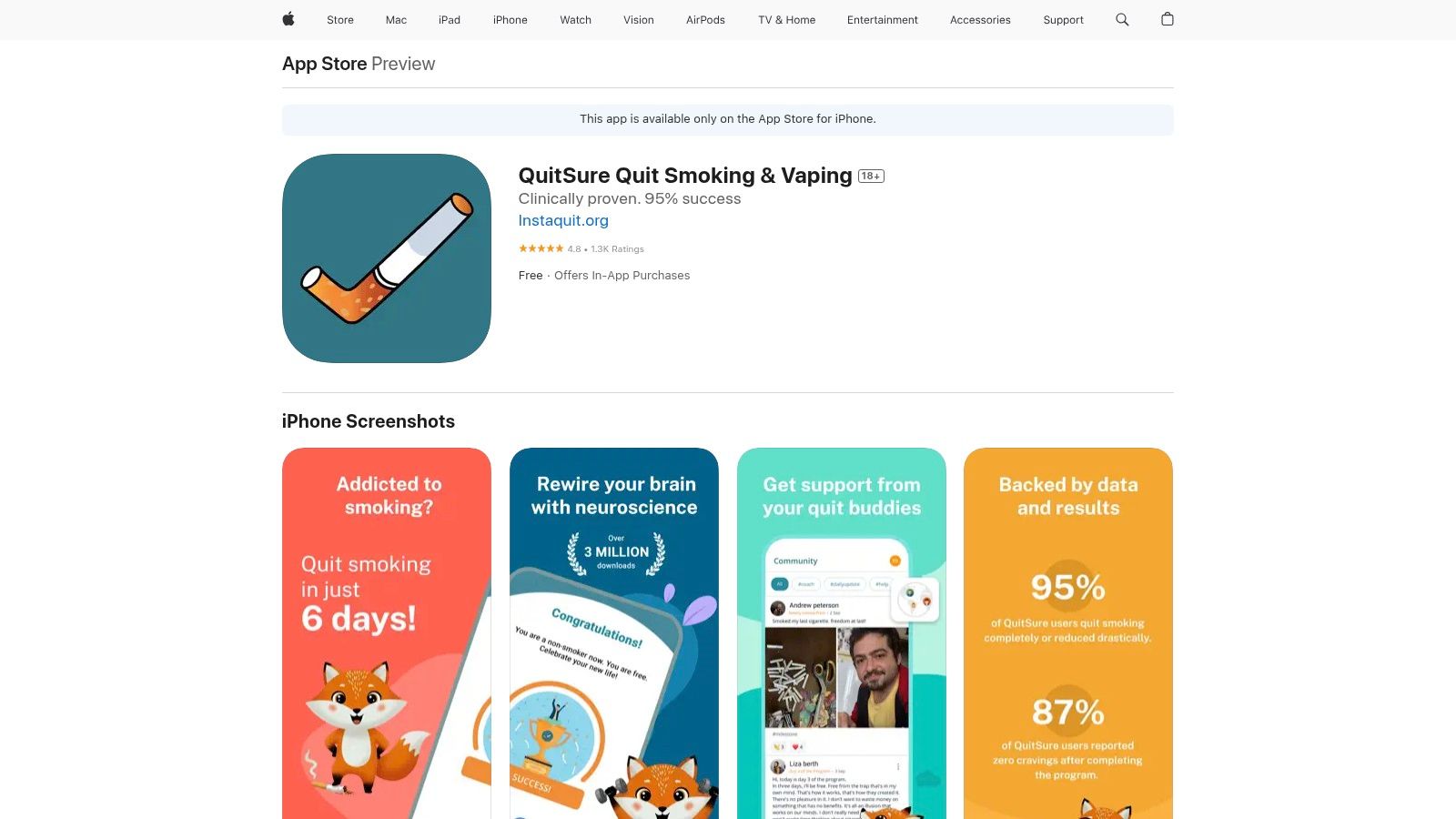
QuitSure offers a distinct, time-boxed approach that frames quitting as a mental puzzle to be solved. It's an educational course designed to rewire subconscious beliefs driving addiction. The program is structured over approximately six days, making it great for users seeking a defined, short-term commitment.
Key Features and User Experience
The experience is built around daily lessons, delivered through videos and short written content. These are followed by "mindful exercises" to deconstruct the user's reasons for smoking. This helps expose smoking triggers as illusions created by addiction.
A key element is the "Final Script" technique, a culminating exercise to cement new understanding and quit. The app's structured curriculum guides users step-by-step. It removes the guesswork and provides a clear path from smoker to non-smoker.
Practical Considerations
QuitSure is a premium app available on iOS and Android, requiring a subscription for full access. While there might be introductory content, the core 6-day course is behind a paywall. Users should be prepared to dedicate about an hour each day to complete the lessons.
Pros & Cons
Pros
Cons
Short, Defined Program: The 6-day timeline feels achievable and less intimidating.
Subscription Required: The core program is not free to use.
Focus on Mindset: Addresses the psychological root of addiction, not just the physical habit.
Limited Clinical Data: Lacks the extensive public research of some competitors.
Supports Vaping & Smoking: Content is tailored for both forms of nicotine use.
Polish Can Vary: Some users note inconsistencies in video and content quality.
Best For: Individuals who have struggled with the "willpower" method and are open to a psychological, educational approach to quit smoking or vaping in a short, structured timeframe.
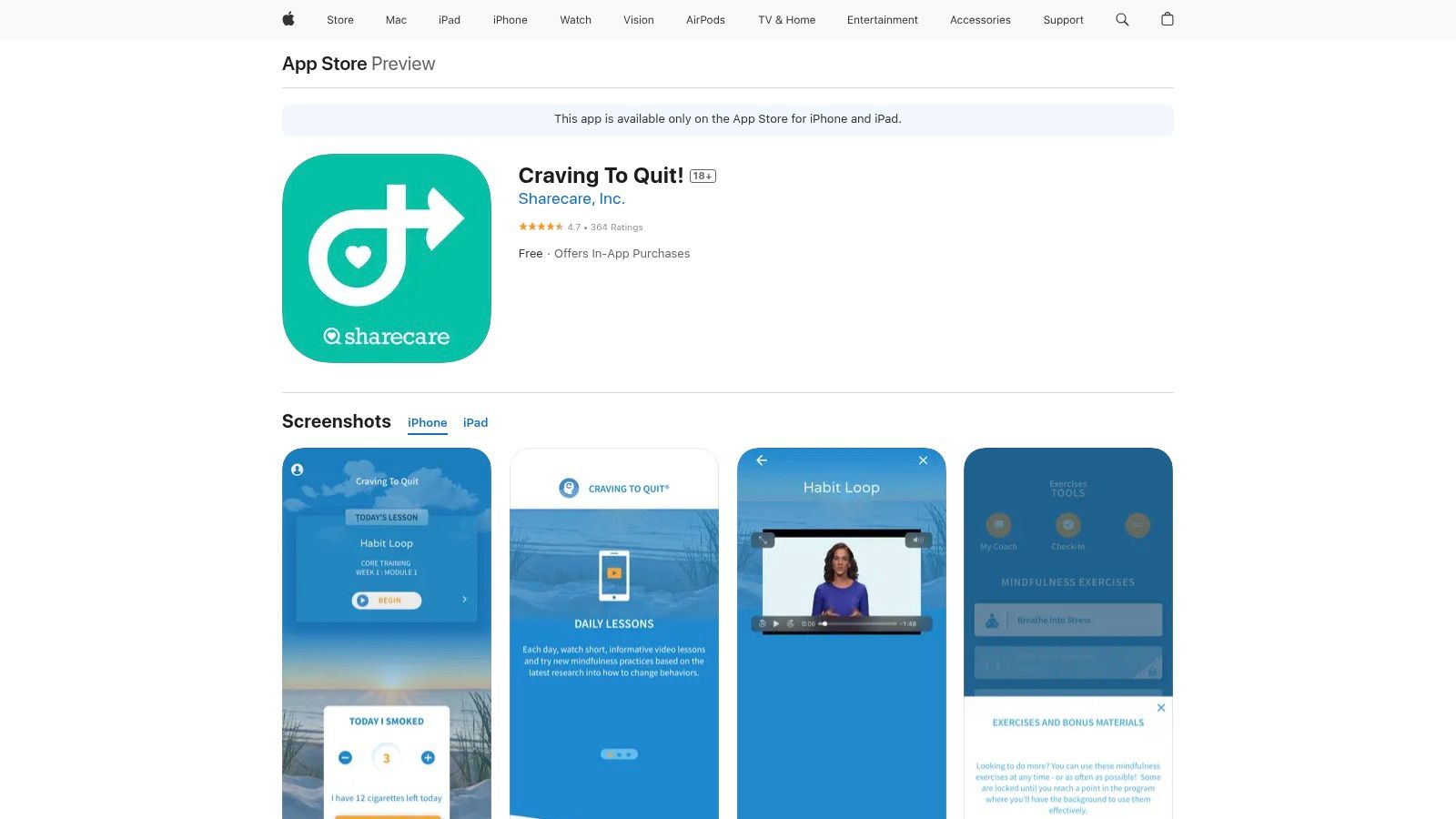
Craving to Quit! takes a unique, mindfulness-based route, retraining the brain's response to triggers. Developed by Dr. Judson Brewer, the program is based on successful clinical protocols from Yale University. It focuses on building awareness to change your relationship with smoking.
Key Features and User Experience
The app's core is a structured 21-day program with daily video and audio lessons. Users learn to recognize cravings, understand the sensations, and ride them out without acting on them. This method directly addresses the psychological loop of addiction, which is often tied to mental health; you can learn more about the link between smoking and mental well-being.
The experience is enhanced with practical tools like a cigarette tracker and goal setting. For more interaction, the platform offers access to a moderated community. This multi-layered support system helps users feel connected and accountable.
Practical Considerations
Craving to Quit! is available for iOS and Android, offering a free trial period. After the trial, continued access to the full 21-day program requires a subscription. The pricing is positioned as a premium service, reflecting its specialized content.
Pros & Cons
Pros
Cons
Strong Mindfulness Pedigree: Based on Yale-tested protocols and brain science.
Subscription Required: Full access is paywalled after the initial trial.
Coaching & Community: Offers accountability and live expert support.
Niche Approach: The mindfulness-first method may not appeal to every user.
Best For: Individuals who are open to a mindfulness-based approach and want to understand and change the root psychological habits behind their smoking addiction.
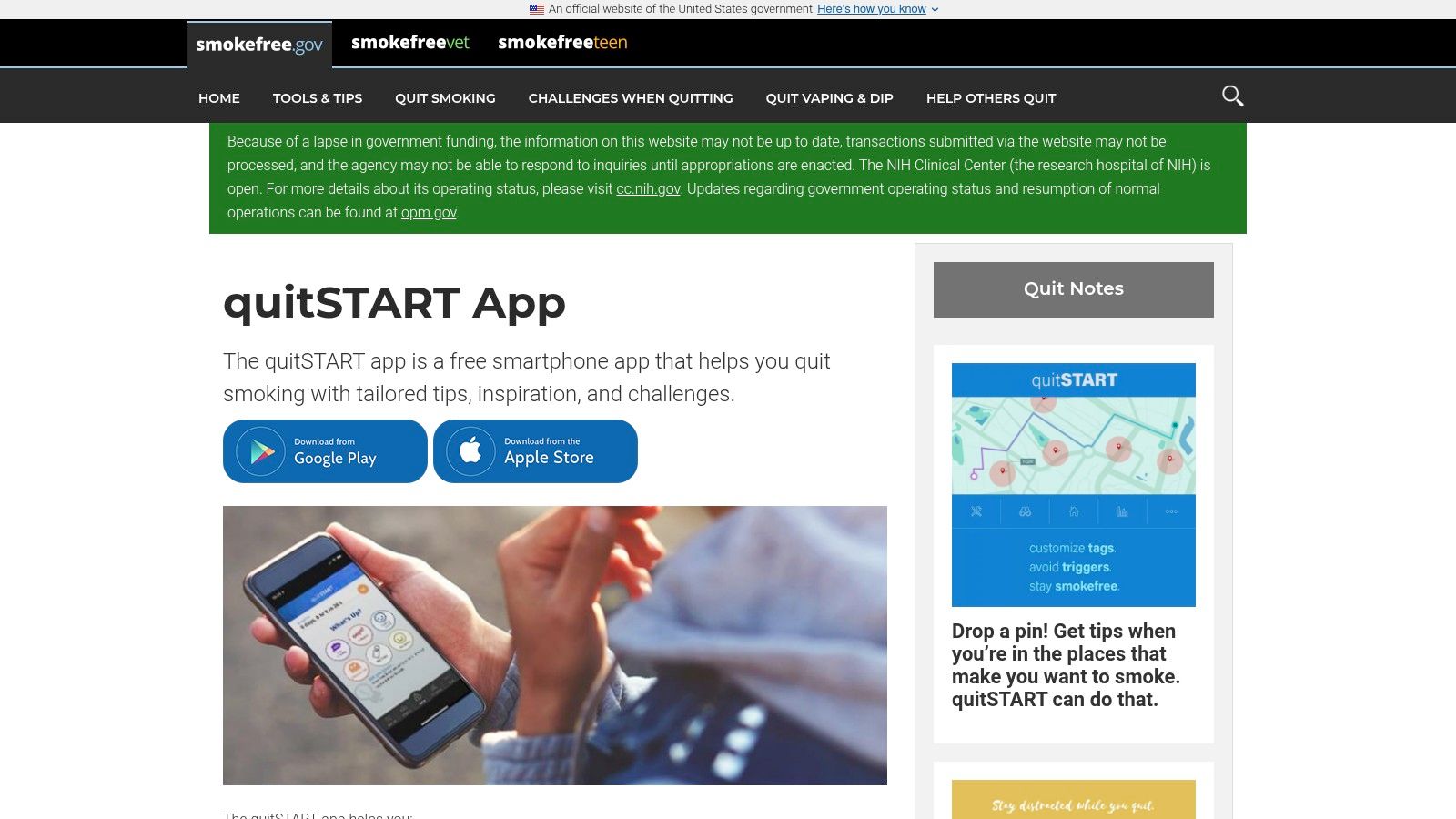
quitSTART offers a straightforward, public-health-backed approach to quitting. Developed by the National Cancer Institute (NCI) and the CDC, this app is free and no-frills. It provides core, evidence-based support without ads or subscriptions.
Key Features and User Experience
The app helps you monitor cravings, track your mood, and celebrate progress with milestone badges. A practical feature is the "Quit Kit," where you can store helpful tips and inspirational photos. When a craving hits, you can access your kit or play mini-games to distract yourself.
The interface is simple and utilitarian, designed for easy navigation. It provides essential tracking for health improvements and money saved. The user experience is direct, providing tips and challenges without overwhelming you.
Practical Considerations
As a government-developed tool, quitSTART is completely free on both iOS and Android. It has no in-app purchases or advertisements. This makes it an accessible starting point for anyone, including teens.
Pros & Cons
Pros
Cons
Free, ad-free, and public-health backed: A completely non-commercial and trustworthy resource.
Utilitarian design: The interface is functional but less polished than premium apps.
Clear, non-commercial guidance: Suitable for youth and adults seeking unbiased support.
Slower update cadence: Features may not evolve as quickly as privately developed apps.
Action-oriented "Quit Kit": Provides immediate, personalized tools for cravings.
Best For: Users who need a simple, free, and reliable quitting tool backed by a public health authority, without any commercial pressure.
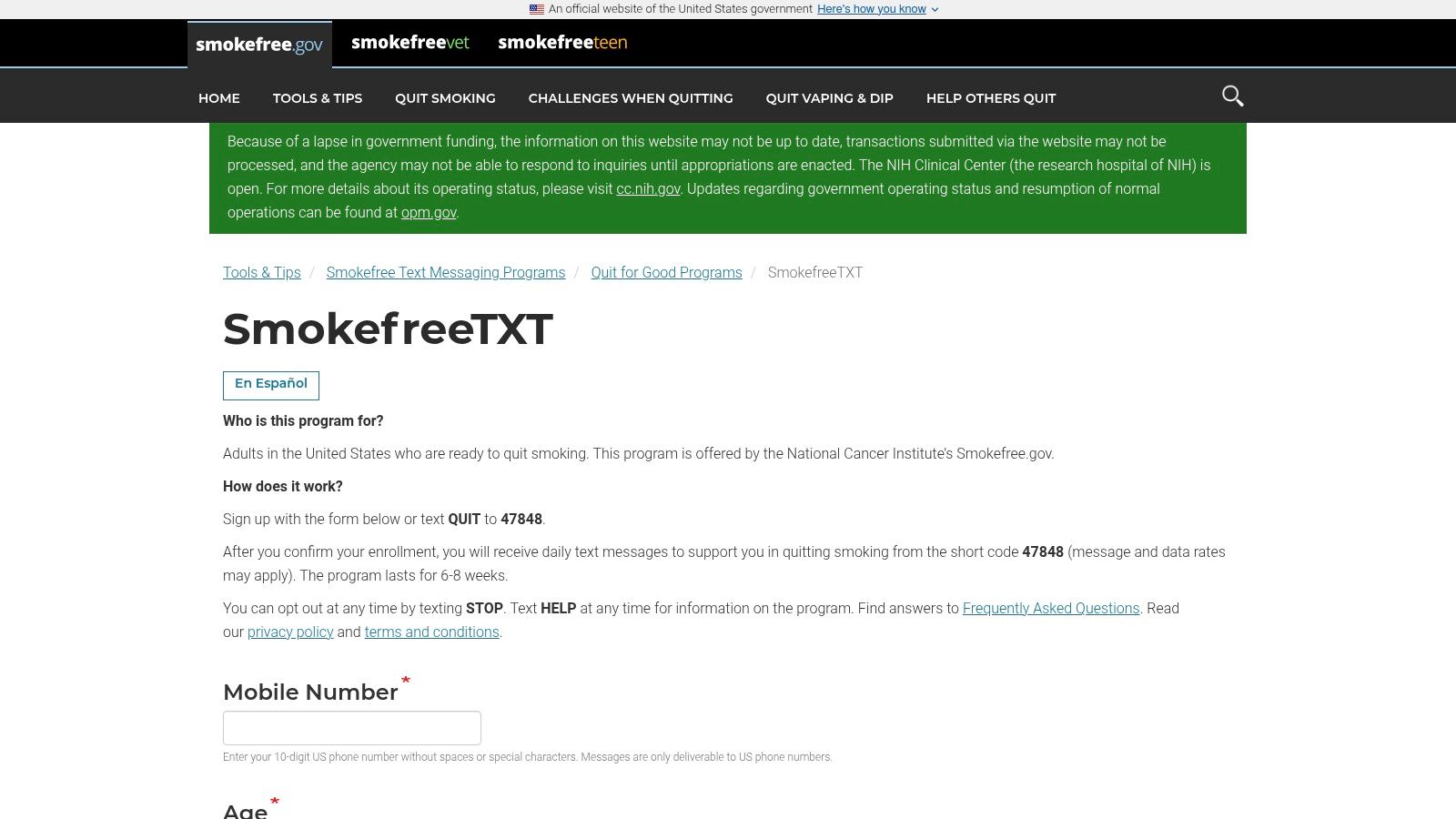
SmokefreeTXT offers a unique, minimalist approach by leveraging text messaging. Developed by the National Cancer Institute (NCI), this evidence-based program delivers support directly to your phone. It's a supportive companion that provides timely advice without requiring a full app.
Key Features and User Experience
The program's core is a 6-to-8-week structured texting plan that sends daily tips and motivation. After enrolling, you set a quit date, and the messages are tailored to your stage in the journey. This ensures you receive relevant advice when you need it most.
A key interactive feature is its use of on-demand keywords. If you're hit with a craving, you can text "CRAVE" to receive an immediate, actionable tip. This makes SmokefreeTXT a highly practical tool that complements other methods.
Practical Considerations
SmokefreeTXT is completely free and available to anyone in the United States with a mobile phone. Enrollment is simple: just text the word "QUIT" to 47848. The service also offers specialized programs for different groups, like veterans and teens.
Pros & Cons
Pros
Cons
Completely Free: No hidden costs or subscriptions, backed by the NCI.
SMS Only: Lacks the rich visuals and detailed dashboards of a traditional app.
Low-Effort Engagement: Integrates easily into daily life without needing a separate app.
Message Frequency: The number of daily texts may feel high for some users.
Highly Accessible: Works on any mobile phone that can receive texts.
Best For: Individuals looking for a straightforward, free, and scientifically backed support system that can be used alone or alongside other quitting tools.
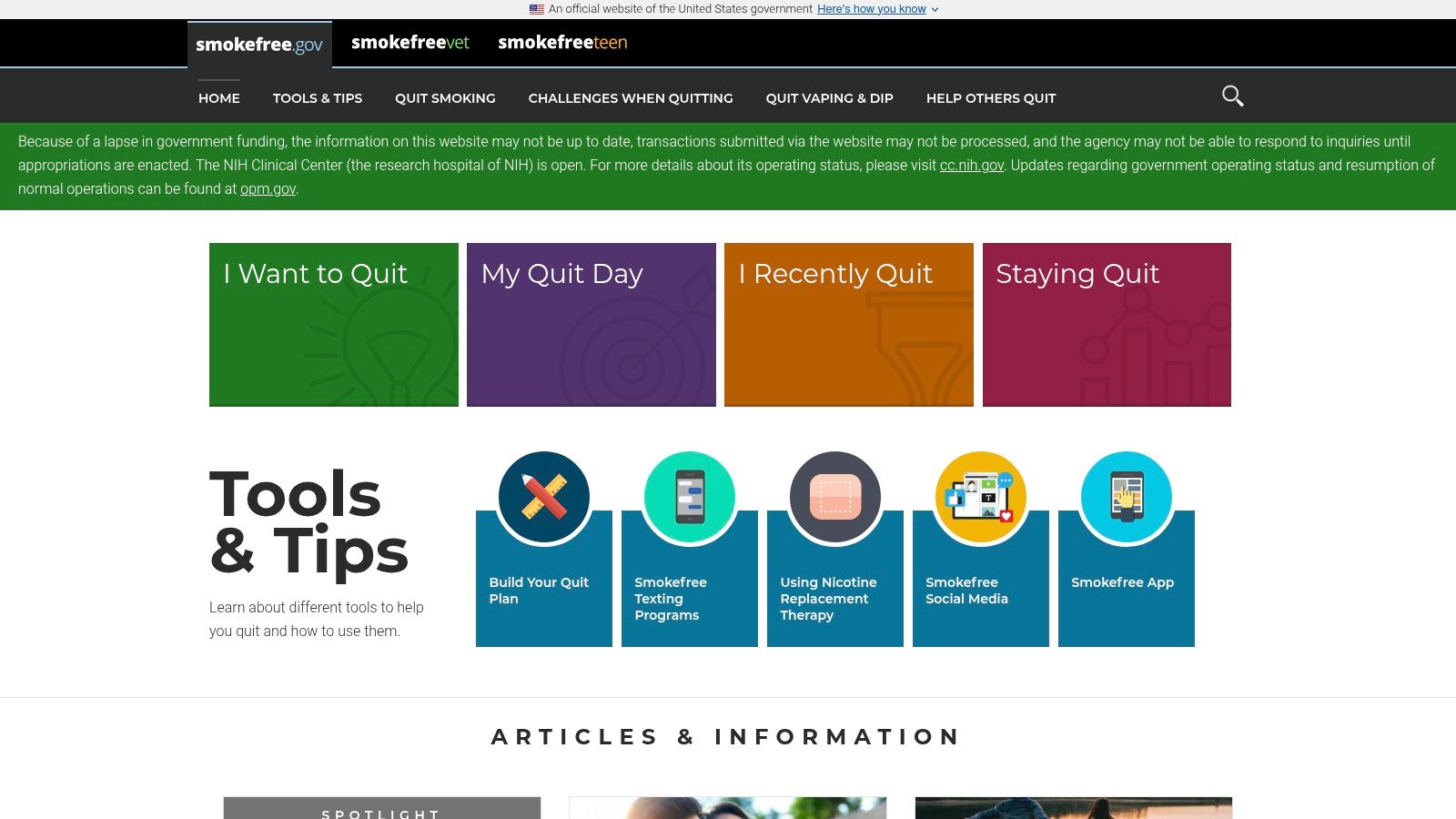
Smokefree.gov is not a single app but a comprehensive, free resource hub from the U.S. National Cancer Institute. It acts as a central command for your quit journey. This platform is a completely free, authoritative, and unbiased source of information.
Key Features and User Experience
The core of Smokefree.gov is its "Build Your Quit Plan" tool. This interactive questionnaire helps you identify your triggers and motivations. This process generates a personalized roadmap for you to follow.
The site also provides direct access to trained counselors through its LiveHelp chat service. The platform serves as a portal to other specialized tools, like the quitSTART app. This makes it a great starting point to explore different strategies for quitting smoking and find what works best.
Practical Considerations
Everything on Smokefree.gov is completely free, with no subscriptions or hidden costs. The website is accessible on any device with a web browser. It connects users to other free services like the national quitline (1-800-QUIT-NOW).
Pros & Cons
Pros
Cons
Completely Free & Authoritative: Backed by the National Cancer Institute.
Less Sleek Interface: Government site design can feel dated compared to modern apps.
Integrates Multiple Support Channels: Connects users to apps, text programs, and live counselors.
Update Delays Possible: Can be affected by government funding schedules.
Personalized Quit Plan Builder: Creates a tailored strategy based on user input.
Best For: Individuals who want a trusted, comprehensive, and completely free starting point that combines planning tools, expert information, and connections to various support services.
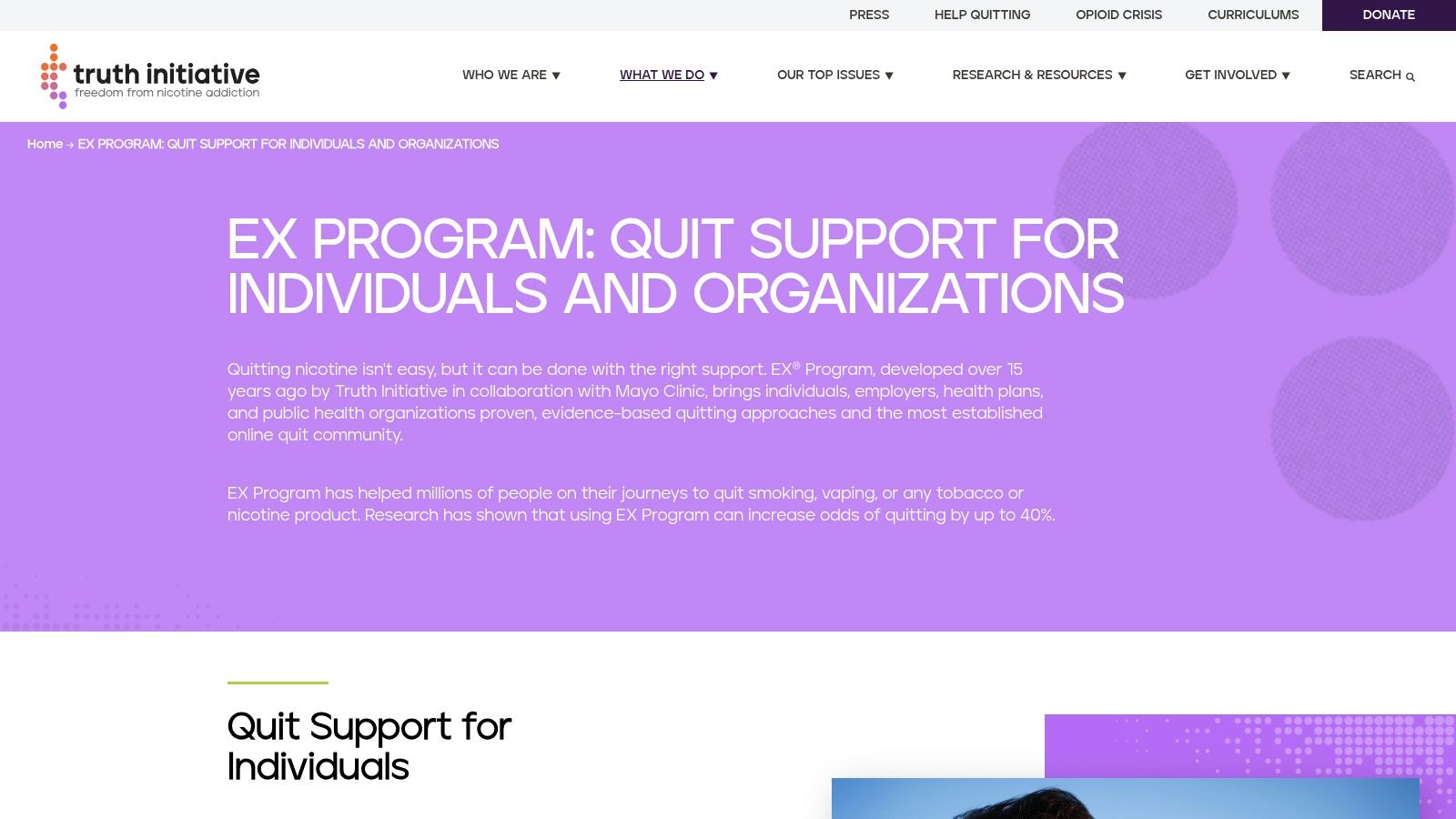
Developed by the Truth Initiative and the Mayo Clinic, the EX Program offers a comprehensive digital quit-smoking platform. It combines a structured plan with one of the largest online communities for peer support. The program focuses on re-learning life without cigarettes.
Key Features and User Experience
The core of BecomeAnEX is its interactive quit plan, which helps users identify triggers and practice coping skills. This is supplemented with daily text messages that provide timely tips and motivation. Its greatest strength is its massive and highly active online community.
The user interface is straightforward, guiding you through the steps of preparing to quit. The experience is less about gamification and more about providing a steady, supportive educational framework. It's a reliable resource.
Practical Considerations
The consumer version of BecomeAnEX is completely free and available to anyone in the United States. This includes the quit plan, community access, and text support. However, more intensive features like one-on-one coaching are part of the enterprise version, offered through employers.
Pros & Cons
Pros
Cons
Strong Clinical Backing: Developed with the Mayo Clinic, ensuring a research-based approach.
Premium Features Locked: One-on-one coaching and NRT are often tied to employer plans.
Large, Active Community: One of the biggest peer support networks available online.
Website Can Be Confusing: Distinguishing between consumer and enterprise versions isn't always clear.
Completely Free for Individuals: The core program is accessible at no cost.
Best For: Individuals looking for a free, clinically-backed program with a strong emphasis on community support and a structured, educational path to quitting.
This is Quitting by Truth Initiative targets a critical demographic: young people looking to quit vaping and nicotine. It forgoes a traditional app for a simple text-messaging system. This approach removes barriers like app downloads and account creation.
Key Features and User Experience
The program's core is its anonymity and simplicity. Users text "DITCHVAPE" to 88709 to enroll and start receiving daily, tailored messages. These texts are crowdsourced from other young people who have successfully quit, creating a relatable support system.
The messages provide tips, encouragement, and motivation at key moments. The user experience is entirely text-based, with no dashboards to check or features to navigate. This makes it incredibly easy and discreet to use.
Practical Considerations
This service is completely free, backed by the nonprofit Truth Initiative. Its primary focus is on vaping, but the advice is applicable to other tobacco products. It works on any mobile phone capable of sending and receiving text messages.
Pros & Cons
Pros
Cons
Completely Free: No cost or hidden fees to use the service.
Text-Only Program: Lacks a visual dashboard or community forum.
Youth-Specific: Content is tailored for and sourced from teens and young adults.
Vaping Focus: While relevant, it is not primarily designed for traditional cigarette smokers.
Low Barrier to Entry: Simple text-to-join makes starting easy and anonymous.
Research-Backed: Its effectiveness has been demonstrated in published studies.
Best For: Teens and young adults who prefer a simple, anonymous, and text-based support system to quit vaping or using nicotine products.
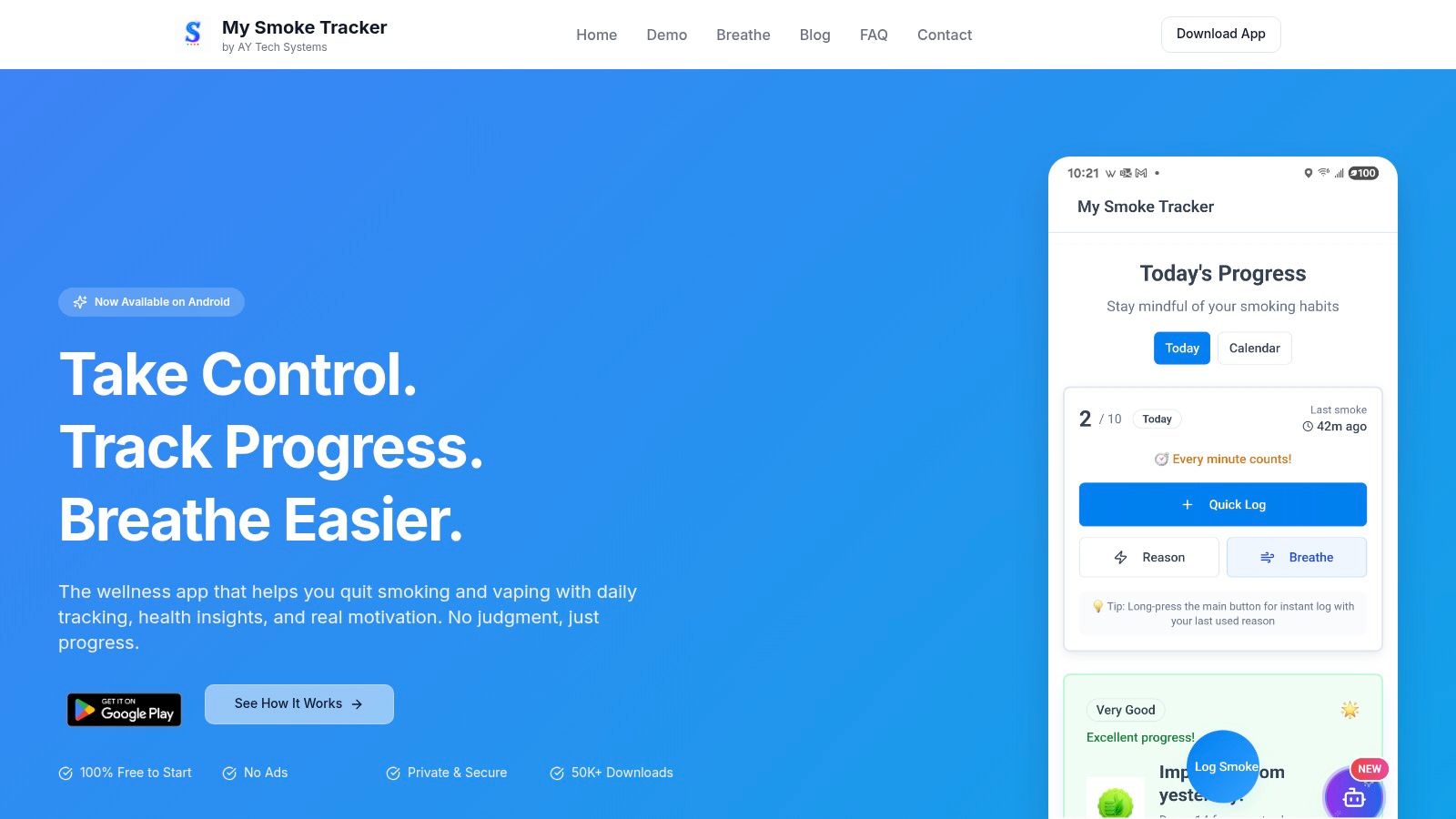
Smoke Tracker offers a refreshingly simple and private approach. It's one of the best quit smoking apps for users who prioritize data security and a no-frills experience. It works entirely offline on your device, making it a great ad-free starting point.
Key Features and User Experience
The user experience is built around simplicity and immediate feedback. The dashboard displays essential metrics like money saved and health milestones reached. One-tap logging allows you to quickly record cravings and note their triggers.
A key feature is its commitment to privacy; all data is stored locally. It also includes guided breathing exercises and an achievements system. This tracker is a useful companion for those also using other methods, such as tobacco use testing.
Practical Considerations
Smoke Tracker is currently available on Android, with an iOS version listed as "coming soon." Its core features are completely free. This makes it highly accessible for anyone wanting to begin their quit journey without a financial commitment.
Pros & Cons
Pros
Cons
Free core features and ad-free experience: No hidden costs or intrusive advertisements.
Android-first: iOS version is not yet available, limiting its user base.
Strict privacy stance: All data is stored locally on your device.
Lacks clinical coaching: No access to human advisors or community support features.
Lightweight and simple: Easy to use without overwhelming features.
Best For: Privacy-conscious Android users who want a simple, offline, and free tool for tracking basic quit metrics and managing cravings.
Anyone seeking comprehensive, official quitting resources
Free
EX Program / BecomeAnEX (Truth Initiative)
Interactive quit plan; daily texts; large community; enterprise options
Mayo Clinic collaboration; clinically backed
Structured program with community and enterprise coaching/NRT
Individuals and organizations wanting clinically backed program
Free individual; enterprise features via employer/plan
This is Quitting (Truth Initiative)
Tailored daily texts by age/product; peer-sourced tips
Youth-focused; published effectiveness research
Low-barrier, youth-specific vaping cessation support
Teens & young adults (13–24) trying to quit vaping
Free (text program)
Smoke Tracker – Quit Smoking & Vaping
One-tap logging; health & savings dashboards; export
Lightweight, ad-free Android-first; strict local privacy
Simple, private tracking with insights and exports
Android users who want local-data, privacy-first tracker
Free core; ad-free
Your Final Takeaway: Choosing the App That Fits You
We've explored a dozen of the best quit smoking apps, each offering a unique path toward a nicotine-free life. The journey reveals a crucial truth: there is no single "magic bullet" app. The most effective tool is the one that aligns with your personality, triggers, and needs.
Think of it like choosing a personal trainer. Some people thrive with a data-driven coach who tracks every metric. Others need a supportive cheerleader who focuses on mental victories. Your ideal app is a personalized partner for one of the most significant health decisions you'll ever make.
How to Choose Your Digital Quit Coach
The sheer number of options can feel overwhelming, but making the right choice is simpler when you break it down. Your selection should be an honest self-assessment. Consider what has worked for you in the past and what you truly need for support this time.
Ask yourself these critical questions before you download:
What is my primary motivation? Is it financial savings, health improvements, or social freedom? Apps like Smoke Free and QuitNow! excel at visualizing your progress with compelling health and financial trackers.
Do I need a structured program or a flexible companion? If you benefit from a clear, step-by-step curriculum, a program like QuitSure or the EX Program might be your best fit. If you prefer a more self-guided tool, Kwit or EasyQuit could be ideal.
Is community support a deal-breaker? For many, sharing the journey with others who understand is vital. Platforms like QuitNow! and BecomeAnEX have robust, active communities that can provide encouragement.
How important is scientific backing to me? If you value methods rooted in clinical research, apps like Craving to Quit! and the government-backed quitSTART are built on proven behavioral science.
Making the App Work for You
Downloading the app is just the first step. True success comes from integrating it into your daily life. The difference between a forgotten icon and a life-changing tool comes down to implementation.
First, customize your settings immediately. Enter your quit date, your smoking habits, and your personal motivations. This transforms the app from a generic tool into your personal quit journal.
Second, commit to daily check-ins. Even if it's just for 60 seconds, opening the app reinforces your commitment. This simple ritual keeps your goal front and center.
Finally, actively use the "panic button" or craving-buster features. Don't wait until you're already reaching for a cigarette. The moment a craving begins, open the app and engage with a game or a breathing exercise. This is how you build new neural pathways.
The best quit smoking apps are powerful allies, but you remain the hero of this story. They provide the map and the support network, but you are the one taking each step forward. Choose the app that feels like the most empowering partner for your unique journey.
To make your quit journey even more successful, understanding the science behind nicotine addiction is crucial. For clear, evidence-based information that cuts through the noise, check out Nic Facts. Our resources can supplement the support you get from your app by empowering you with knowledge. Learn more at Nic Facts.
TLDR: Tobacco use testing finds the chemical "footprints" of tobacco, mainly by looking for nicotine's stable byproduct, cotinine. By analyzing samples like urine, saliva, or hair, these tests give a clear picture of recent or long-term use. This is a proven way to verify smoking status for health checks, insurance, and clinical research.
When you hear about tobacco use testing, it’s not just about catching someone smoking. It's a scientific method for confirming exposure to tobacco. The process looks for specific chemical clues left behind in the body.
The main suspects are nicotine and its key byproduct, cotinine. These tests check biological samples—like urine or saliva—to get a clear picture of recent use.
What Tobacco Use Testing Really Tells Us
Think of it like a biological detective story. When someone uses a tobacco product, their body immediately gets to work processing the nicotine. In doing so, it creates and leaves behind certain tell-tale clues.
The most reliable of these clues is a substance called cotinine. While nicotine itself is a bit of a fleeting character and disappears from the body pretty quickly, cotinine hangs around for much longer.
This longer lifespan is what makes it such a dependable marker for confirming tobacco exposure. In fact, testing for cotinine gives a far more accurate and reliable picture than just searching for nicotine alone.
Why It Matters
Knowing a person’s true tobacco use status is critical in many different scenarios. It helps doctors and healthcare providers tailor the right support and cessation plans. It also gives insurance companies the accurate information they need to assess risk fairly.
For scientists and researchers, it’s the only way to gather truly reliable data for studies. At its core, the goal is to get objective, undeniable proof of tobacco exposure.
For anyone committed to understanding this topic on a deeper level, it's worth digging into the science. You can find more detailed and objective information by exploring resources on nicotine facts.
How Tobacco Use Testing Actually Works
Think of tobacco use like leaving footprints in the sand. Nicotine is the fresh, clear footprint left right after a step—it's there, but the tide will wash it away quickly.
Cotinine, a substance your body makes from nicotine, is like a plaster cast of that footprint. It lasts much longer and gives a clearer, more durable record of what happened.
That’s why cotinine, not nicotine, is the real star of the show in tobacco testing.
To really get how these tests work, you have to follow the chemical trail left behind in the body. When someone smokes a cigarette, vapes, or uses a nicotine pouch, nicotine floods their system.
It's the compound that gives tobacco its kick. But nicotine is a fleeting guest.
It has a very short half-life—the time it takes for your body to clear out half of it—of only about two hours. This means if you were trying to test for nicotine itself, you'd have a tiny window to catch it.
The Transformation: From Nicotine to Cotinine
Your liver is a master at processing everything you put into your body, and nicotine is no exception. When nicotine shows up, the liver quickly breaks it down into various other compounds, called metabolites.
The most important one for testing purposes is cotinine. It’s a simple conversion: nicotine comes in, and the liver turns about 70-80% of it into cotinine.
This metabolic process is the key to reliable testing. Why? Because unlike its parent compound, cotinine sticks around for a whole lot longer.
It has a half-life of roughly 16 to 20 hours. This extended stay makes it the perfect biomarker—a biological signpost—for recent tobacco exposure.
A biomarker like cotinine gives us a historical record, not just a momentary snapshot. Searching for nicotine is like trying to catch a sprinter in a photo finish; finding cotinine is like looking at the official race results posted hours later. It’s just far more dependable.
Why Cotinine Is the Gold Standard
That much longer detection window is precisely why cotinine has become the preferred target for almost every type of tobacco test. It paints a more complete picture of someone’s tobacco use over the past few days, not just the last couple of hours.
This stability gives testers several major advantages:
A Wider Window: You can find cotinine in urine for up to three or four days after someone last used tobacco.
Shows a Pattern of Use: Cotinine levels can help tell the difference between a daily smoker and a casual user.
Highly Specific: Cotinine is produced almost exclusively from nicotine, meaning the risk of a false positive is practically zero.
By focusing on this stable metabolite, labs can confidently determine if someone has been exposed to nicotine. Cigarettes, vapes, chew, or patches—they all leave the same trail of cotinine.
This simple metabolic trail is precisely why cotinine has become the gold standard biomarker for accurate tobacco use testing.
Comparing Different Types of Test Samples
Choosing the right sample for a tobacco test is like picking the right tool for a job. You wouldn't use a sledgehammer to hang a picture frame.
Each sample type—urine, saliva, blood, and hair—offers a unique window into a person's tobacco exposure. Understanding their individual strengths and weaknesses is absolutely critical.
Let's break down these biological "detectives" to see what secrets each one can uncover.
Urine Testing: The Reliable Workhorse
Urine testing is, by far, the most common method for detecting tobacco use. It’s non-invasive, cost-effective, and provides a dependable look at recent exposure. Think of it as the family sedan of testing—it gets the job done consistently and affordably.
A urine test primarily looks for cotinine, which can typically be detected for about 3 to 4 days after last use. For heavy, long-term smokers, this window can sometimes stretch to a week or even more.
This makes it ideal for common scenarios, like pre-employment screening or insurance applications.
Saliva Testing: The Rapid Responder
If urine testing is the reliable sedan, then saliva testing is the nimble scooter—perfect for quick, on-the-spot checks. Saliva tests are incredibly easy to administer, requiring just a simple swab of the mouth.
This has made them a popular choice for situations that need immediate results. The trade-off for this speed and convenience is a shorter detection window.
Cotinine is usually only detectable in saliva for about 24 to 48 hours after the last use. This makes it highly effective for confirming very recent tobacco consumption.
Blood Testing: The Forensic Expert
Blood testing is the forensic specialist in the world of tobacco screening. It offers the highest level of accuracy and precision you can get. It can measure the exact concentration of both nicotine and cotinine in the bloodstream.
This makes it invaluable for scientific research where exact exposure levels are critical. However, this precision comes at a price.
Blood tests are the most invasive and expensive method. The detection windows are also relatively short: nicotine is gone in hours, while cotinine can be found for up to 2-3 days.
Because of its invasive nature and cost, blood testing is generally reserved for situations where quantitative data is essential. For most routine screenings, the accuracy of urine or saliva tests is more than sufficient.
Hair Testing: The Historian
Finally, we have hair testing—the long-term historian. While other tests give you a snapshot of the last few days, a hair follicle test provides a panoramic view of the past several months.
As your hair grows, it traps biomarkers like cotinine, creating a permanent timeline of exposure. A standard 1.5-inch hair sample can reveal tobacco use patterns over the previous 90 days.
This makes it an excellent tool for monitoring long-term abstinence in smoking cessation programs. The main downsides are its cost and inability to detect very recent use.
Long-term monitoring is part of a larger global strategy to curb tobacco use. For instance, the push for graphic health warnings on tobacco packaging has seen incredible progress. You can read the full report on global tobacco epidemic trends for more details.
Each testing method offers a different piece of the puzzle. The table below breaks down the key differences.
Comparing Tobacco Test Sample Types
Sample Type
Detection Window
Accuracy
Invasiveness & Cost
Best For
Urine
3-4 days (up to 1-2 weeks for heavy users)
High for detecting recent use.
Non-invasive & Low Cost.
Routine screenings, insurance, employment, and smoking cessation check-ins.
Saliva
24-48 hours
High for very recent use.
Non-invasive & Low-to-Moderate Cost.
On-the-spot testing, roadside checks, and verifying use within the last day.
Blood
2-3 days (Nicotine: just hours)
Very High (Quantitative). Measures exact concentrations.
Invasive & High Cost. Requires a clinical setting.
Scientific research, clinical trials, and situations needing precise data.
Hair
Up to 90 days or longer.
High for long-term patterns.
Minimally invasive & High Cost.
Long-term abstinence monitoring, legal cases, and historical use verification.
Ultimately, the best test depends entirely on what you need to find out. Are you looking for a quick "yes" or "no," or do you need a detailed history? Answering that question is the first step in choosing the right tool.
Understanding Test Accuracy and Limitations
TLDR: No tobacco use test is 100% flawless. Test accuracy is measured by sensitivity (correctly identifying users) and specificity (correctly identifying non-users). Things like heavy secondhand smoke or testing too early/late can cause errors, which is why follow-up tests are sometimes needed for a complete picture.
While today's tobacco tests are incredibly reliable, no single test is perfect. Think of it like any other diagnostic tool—each one comes with its own strengths and potential weaknesses.
Understanding these nuances is the key to interpreting the results correctly. Test accuracy isn't just a simple "yes" or "no" answer.
It's really a delicate balance between two core concepts: sensitivity and specificity. Once you get a handle on these two ideas, you’ll have a much clearer picture of what a test result truly means.
Sensitivity and Specificity Explained
Imagine a test is like a security guard at an exclusive event. The guard has two main jobs: let the invited guests in and keep uninvited people out.
Test accuracy works pretty much the same way.
Sensitivity is the test's ability to correctly identify a tobacco user. This is the guard successfully spotting every single person who tries to crash the party.
Specificity is the test's ability to correctly identify a non-user. This is the guard recognizing all the invited guests and waving them through without any issue.
In a perfect world, a test would be 100% sensitive and 100% specific. In reality, labs work hard to get as close to this ideal as possible.
The Puzzle of a False Positive
A false positive is when a test flags someone for tobacco use when they haven't actually used it. This is our security guard mistakenly accusing an invited guest of being a party crasher.
While this is very rare with modern cotinine tests, a few things can muddy the waters. The most commonly cited concern is heavy, prolonged exposure to secondhand smoke.
For a non-smoker to test positive, they'd likely need to be in a small, unventilated room with intense smoke for many hours. The cotinine levels from passive exposure are typically far below the cutoffs for standard tests.
It's important to understand that a positive result from a highly specific test, like a cotinine screen, is overwhelmingly likely to be accurate. The scenarios that might lead to a false positive are outliers, not everyday occurrences.
Unpacking a False Negative Result
On the other side of the coin, you have the false negative. This happens when a test fails to detect tobacco use in someone who is a user. This is our security guard failing to notice a party crasher slipping right past them.
This type of error is more common and usually comes down to simple timing. The biggest reason for a false negative is testing outside the detection window.
If someone uses tobacco and then waits just long enough for the cotinine to clear, the test will come back negative. The level of exposure also matters.
Ultimately, understanding a test's limitations is empowering. It gives you a realistic view of what the results mean and underscores why context is so incredibly important.
Where Tobacco Testing Is Used in the Real World
TLDR: Tobacco use testing isn't just a lab procedure—it's a practical tool used every day to improve health and safety. It's essential in workplaces to ensure safety, in clinical trials to guarantee accurate research data, and in smoking cessation programs to provide motivation and track real progress. From insurance applications to personal health journeys, these tests offer objective proof of tobacco exposure, turning scientific data into real-world action.
The science behind tobacco use testing is fascinating, but its real power comes from its use in everyday life. These tests are much more than academic exercises. They are practical tools that influence major decisions in healthcare, workplaces, and scientific research.
Understanding where and why these tests are deployed helps connect the dots. From making sure a construction worker is alert to verifying data in a medical study, tobacco testing plays a crucial role.
Workplace Screening Programs
Many employers, especially in safety-sensitive industries, include nicotine screening in their hiring process. Think about jobs where a split-second lapse in concentration could be catastrophic—like airline pilots or heavy machinery operators.
Companies often test for nicotine to minimize risks and ensure their team is focused and healthy. Insurance is another major driver.
Companies that enforce smoke-free workplace policies often get lower premiums on health and life insurance. Tobacco use testing gives them a verifiable way to uphold these policies.
Validating Clinical Trial Data
Scientific research, particularly in medicine, must be built on clean, reliable data. When scientists study a new drug, a participant's smoking status can throw off the results in a big way.
Imagine a study testing a new lung health medication. If a chunk of the "non-smoker" group is actually smoking, the study’s findings could be completely skewed.
To prevent this, researchers use cotinine tests to biochemically confirm that the non-smoking group is truly smoke-free.
In research, what people say they do doesn't always match reality. Self-reporting is notoriously unreliable, which is why objective biochemical verification through tobacco use testing is the gold standard for ensuring the integrity of clinical trial data.
Blood tests are often the top choice in these settings because they deliver precise data. This step ensures that the conclusions drawn from the research are valid and can be trusted.
Supporting Smoking Cessation Programs
Quitting tobacco is an incredibly tough journey, and getting objective feedback can be a powerful motivator. Smoking cessation programs often use cotinine testing to help people track their progress.
Seeing a test result come back negative delivers a tangible win, reinforcing their commitment. These tests also help healthcare providers tailor their support.
For anyone on this path, learning the facts can be empowering. You can understand the science behind nicotine to arm yourself with more objective information.
Despite the difficulty of quitting, global efforts are making a real impact. Tobacco use has been on a downward trend, with the number of users dropping. You can find more insights in the World Health Organization's report on tobacco trends.
Frequently Asked Questions About Tobacco Testing
Long story short: Yes, vapes and e-cigarettes absolutely show up on standard tests. We'll also explain how labs can easily tell the difference between a smoker and someone who's just been around secondhand smoke. And finally, we'll give you a clear breakdown of how long nicotine and its byproducts hang around in your urine, saliva, blood, and hair.
Digging into the world of tobacco use testing always brings up some very specific questions. The science is one thing, but how it all plays out in real life is what most people really want to know.
Let's cut through the noise and get straight to the answers for the most common questions we hear.
Can Secondhand Smoke Make Me Fail a Test?
This is probably the number one question we get, and the short answer is: it’s virtually impossible. While you do absorb tiny amounts of nicotine from passive smoke, modern lab tests are designed to tell the difference.
Think of it this way: a test is looking for a flood, not just a bit of morning dew. Labs set a specific cutoff level for cotinine, and your sample has to be above that level to be considered positive.
The amount of cotinine from even heavy secondhand exposure almost never comes close to these thresholds. For everyday life, the risk is practically zero.
Key Takeaway: Don't sweat the secondhand smoke. Lab tests are smart enough to distinguish the high cotinine levels of an active user from the trace amounts you might get from passive exposure.
How Long Does Nicotine Actually Stay in My System?
This is a tricky one because the answer really depends on what’s being tested—and on you. Nicotine itself disappears pretty quickly, but its main byproduct, cotinine, sticks around much longer.
Here’s a general guide to how long labs can detect cotinine:
Urine: For a casual user, cotinine is usually detectable for about 3 to 4 days.
Saliva: Saliva has a much shorter memory, detecting cotinine for only about 24 to 48 hours.
Blood: A blood test can spot cotinine for up to 2 or 3 days.
Hair: Hair is the ultimate long-term record keeper, revealing use for up to 90 days.
Keep in mind, these are just estimates. Things like your personal metabolism and how much you use can affect how quickly your body gets rid of these substances.
Do Vapes and E-Cigarettes Show Up on Tests?
Yes, one hundred percent. This is a huge point of confusion.
Tobacco use testing isn't just about cigarettes—it's about nicotine, plain and simple. It doesn't matter if that nicotine came from a cigarette, a vape, a nicotine pouch, or a patch.
When you use any of these products, your liver breaks down the nicotine into cotinine. A standard lab test is just looking for that cotinine.
The result is the same: a positive test for nicotine use. In fact, the explosion of new nicotine products has made this kind of testing more important than ever.
If you have other questions or want to get into the weeds on a specific part of tobacco testing, please feel free to reach out to our team of experts. We're here to give you clear, objective information.
At Nic Facts, we are dedicated to providing clear, objective, and evidence-based information about nicotine. Explore our resources to deepen your understanding at https://nicfacts.org.